
Government-Funded Media in the US: First Amendment Explainer
The First Amendment prevents the government from determining who is and is not a journalist and, to a large degree, from telling journalists what they can and cannot say.
And, unlike many countries around the world, there are no state-run or official media channels in the United States.
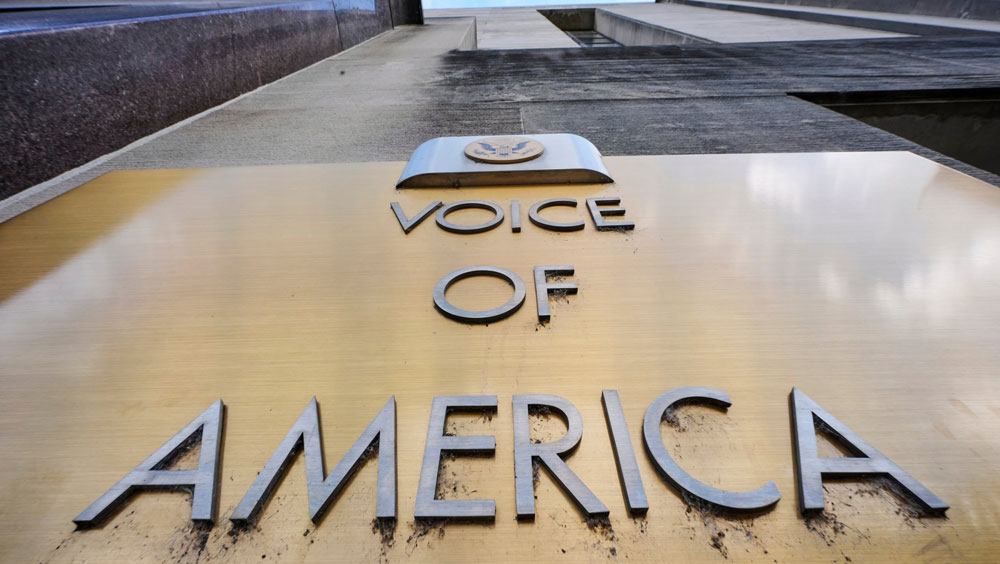
However, there has been an official U.S. media outlet for overseas audiences, the Voice of America, since World War II. But it’s prohibited from broadcasting its signal into the United States, although people in the country can obtain it online, and federal law specifically protects VOA’s editorial independence from being undercut by political appointees.
The government has provided federal funds to VOA and other news organizations broadcasting to international audiences and, through the now-dissolved Corporation for Public Broadcasting, to the Public Broadcasting Service and National Public Radio, two domestic media outlets, since the late 1960s.
Questions have surrounded the government’s funding of these media outlets, ranging from whether the government should fund media at all to whether the government could, or should, ensure that the content these media outlets produce is objectively balanced and accurate.
This article looks at the state of government-funded media. We explore why the government provides financial support for media outlets that deliver news and how those outlets maintain their editorial independence. We also discuss whether government-funded media raises First Amendment concerns and the legal challenges around cutting that funding.
How does the U.S. government fund news organizations?
The U.S. government has provided funding for several media outlets that broadcast news, information and entertainment inside and outside the U.S. — although Congress cut much of that funding in July 2025 for fiscal years 2026 and 2027.

Domestic media
Until recently, the Corporation for Public Broadcasting, a nonprofit created by Congress in 1967 to promote and support public broadcasting, distributed money from Congress to NPR, PBS and more than 1,500 local stations.
The organization was also responsible for ensuring those stations met certain obligations to maintain fair and equitable coverage. Public funding represented about 15% of public broadcasting revenue while stations raised the rest with public donations and sponsorships.
The CPB did not produce programming and did not own or control any networks or individual stations. It simply distributed the money it received from Congress to the news organizations and stations it oversaw through grants.
The CPB dissolved in January 2026 due to funding cuts.
Overseas media
Congress also funds six U.S. broadcast networks with overseas audiences through independent government agency called the U.S. Agency for Global Media, whose mission is “to inform, engage and connect people around the world in support of freedom and democracy.”
These six networks receive all or almost all their funding from the government (according to these outlets’ tax forms) but enjoy independence from government interference through several requirements, including a clear prohibition on political intervention in newsgathering and publication.
Two of these federal networks are part of the of the U.S. government, with leadership and staff who are government employees:
- Voice of America: Established in 1942, this is the largest U.S.-funded international broadcaster, reaching more than 350 million people in nearly 50 languages via radio, television and the internet.
- Office of Cuba Broadcasting: Better known as Radio Martí and TV Martí, its mission is to provide objective news and information to the people of Cuba.
The remaining four government-funded networks under the USAGM are nonprofit media outlets:
- Radio Free Europe/Radio Liberty: It broadcasts in 27 languages to 23 countries and reaches more than 47 million people, most of whom live in countries where a free press does not exist.
- Radio Free Asia: It broadcasts to some Asian countries with challenging media environments and few protections for the press, like China, North Korea, Vietnam, Cambodia, Laos and Myanmar.
- Middle East Broadcasting Networks: An Arabic-language news organization, it reaches 5 million people in the Middle East and North Africa, where press freedom is generally considered very limited, and journalists often face physical threats.
- Open Technology Fund: Originally a part of Radio Free Asia, this became its own entity in 2019. Its purpose is to support and fund digital security and privacy protections for journalists around the world.
Press freedom and government funding of media
Some media companies, both domestic and international, are facing financial challenges that may threaten the existence of small, independent news outlets. Government funding, like other financial support for media, can help ensure that the public has free access to news, information and culture, and particularly to essential emergency information. In the U.S., while federal funding constitutes only a small share of public broadcast revenue, it makes up 99%-100% of funding for those six U.S. networks with overseas audiences, according to these outlets’ tax forms.
U.S. government-funded media with overseas audiences often provides the only source for a free and independent press in the countries in which they broadcast. This can lead to increased civic participation and government oversight.
In this sense, government funding of media strengthens a free press.
But it can also undercut press freedom.
Freedom of the press has always been understood to mean that there will be no government interference with newsgathering, editorial decision-making and publication. Yet, government funding often comes with conditions, which can provide the government with leverage to threaten editorial independence.
Government funding of media may also create bias, rather than eliminate it; media outlets may change their reporting or self-censor. And even the existence of government funding may undermine the appearance of independence in the public’s eye.
Legal barriers to removing government funding
There aren’t many cases (yet) regarding government decisions to withdraw funding for media. But past cases indicate that the government violates the First Amendment when it singles out individual media outlets for unfavorable financial treatment.
For example, the U.S. Supreme Court has said that income taxes targeting specific newspapers, or taxes on supplies for specific newspapers or magazines, violates the First Amendment.
Federal courts have similarly found that the government cannot revoke, or threaten to revoke, financial benefits — such as paid government advertising in a newspaper, subsidies to offset business-related costs or tax exemptions — to punish critical coverage or to coerce favorable coverage.
Generally, the government cannot take away funding for reasons that violate the First Amendment, most specifically to promote a particular viewpoint or punish someone for dissent or criticism.
The bottom line on government-funded media and the First Amendment
The U.S. Constitution gives Congress broad power to spend the federal government’s money, including to fund media organizations. It can attach conditions to the receipt of federal funds, as long as those conditions don’t violate the First Amendment. Congress can also decide to rescind funding, as long as the decision isn’t in retaliation for the exercising of First Amendment or other constitutional rights.
The executive branch also has some power when it comes to cutting federal funding, although it has more restrictions around this authority than Congress, especially when it decides to cut off funds allocated by Congress in retaliation for speech or expression it does not like.
Kevin Goldberg is a vice president and First Amendment expert at Freedom Forum. He can be reached at [email protected].
Katie Bernard is a rapid response writer at Freedom Forum. She can be reached at [email protected].

Recording in Public: Is It Illegal to Record Without Permission?
Horse Race Journalism: Finding Election Coverage Beyond the Polling Numbers
Related Content