
Where America Stands
2025 survey presented by Freedom Forum
The First Amendment remains vital to Americans …
In a time when America feels fractured — by political party, ideology and culture — the First Amendment has the potential to be a uniting force.
As issues around religion, free expression, the press and protest collide with emerging technologies and political polarization, the data suggests public confusion has grown.
General awareness of the First Amendment is high and has remained steady over the past five years of the “Where America Stands” survey: 95% of people have heard of it.
Nine in 10 people agree that the First Amendment is vital, and 64% of respondents say the First Amendment should never be changed, up 10 points from 2020.

9 in 10 agree the first amendment is vital
But while admiration for the First Amendment is widespread, understanding of its five freedoms is uneven. As new technologies, social movements and legal debates reshape the boundaries of expression, Americans are increasingly divided — not on whether the First Amendment matters, but on what it means, who it protects and how far its guarantees should go.
… But they don’t always know what it means for them
Beyond basic awareness, understanding of First Amendment freedoms is much less widespread. While 73% of people surveyed could recall freedom of speech without aid, only 37% could identify freedom of religion — the second most identified freedom. Freedom of petition, historically the least known freedom, continues to have low unaided awareness at 13%.
When asked to name all five freedoms unaided, one in 10 could do so, up from 6% last year. But a quarter of Americans still cannot name even one freedom without prompting.
Americans’ unaided identification of First Amendment Rights
73% Speech | 37% Religion | 26% Assembly | 25% Press | 13% Petition
Respondents were quizzed on a variety of true and false statements about First Amendment protections and found that, while 90% of people correctly identified that it applies to all levels of government, some misunderstandings persist:
- 24% didn’t know public schools can enforce a student dress code.
- 37% didn’t know elected officials can reference religious ideas and personal beliefs while operating in an official capacity.
- 34% mistakenly think school administrators can limit high school students’ right to protest based solely on disagreement with the cause.
More than a quarter (28%) of respondents were unclear about how the First Amendment affects their everyday lives, a five-point increase from last year, answering either that the First Amendment does not affect their daily lives or that they are not sure how it does.
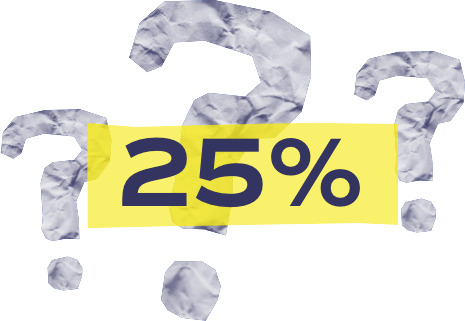
A quarter of Americans cannot name one freedom without prompting.
When asked to compare individual liberties found in the Bill of Rights against the First Amendment, those surveyed sided with the latter; no other right received majority support against the First Amendment. The closest was the right to due process of law under the Fifth Amendment at 39%. And the breakdown of who values the First Amendment versus amendments including the Second, Fourth, Fifth, Sixth and Eighth is heavily affected by race and socioeconomic status. Of particular note is that Black (49%) and Asian (48%) respondents viewed the Fifth Amendment right as equally important to the First Amendment.
| Right Seen as More Essential than the First Amendment | White | Black | Hispanic | Asian | Income <$60k | Income $60-100k | Income >$100k |
|---|---|---|---|---|---|---|---|
| The right to bear arms (2nd Amendment) | 27% | 30% | 18% | 13% | 29% | 21% | 20% |
| The right to be free from unreasonable search and seizure (4th Amendment) | 24% | 39% | 24% | 22% | 29% | 25% | 22% |
| The right to due process of law in criminal cases (5th Amendment) | 36% | 49% | 41% | 48% | 39% | 42% | 39% |
| The right to a fair trial (6th Amendment) | 29% | 39% | 34% | 41% | 34% | 34% | 27% |
| The right to be free from cruel and unusual punishment (8th Amendment) | 28% | 40% | 25% | 28% | 33% | 23% | 28% |
Some even feel that the First Amendment goes too far in the rights it guarantees: 23% of Black respondents and 19% of Hispanic respondents share this view, higher than the national average of 13%. Young people are also likelier to say this than older generations: 17% of Gen Z and 19% of millennials agree, compared to just 9% of Gen X and baby boomers.
“The First Amendment goes too far.”
23% of Black Respondents | 19% of Hispanic Respondents |
17% of Gen Z | 19% of Millennials
Americans still self-censor
Despite awareness of the First Amendment, a majority (65%) of Americans say they are afraid to speak freely, although this has improved since last year (71%).
The most cited reasons for not speaking up include:
- Fear of a violent response (42%).
- Fear of tension between friends and family (37%).
- Fear of being perceived in a certain way (33%).
These fears have all trended downward by two to three percentage points since last year. More than a third (35%) of people surveyed say that nothing keeps them from speaking, up from 29% last year.
Young people are also overwhelmingly more likely to say they’re afraid to speak: 82% of Gen Z versus 58% of baby boomers say they don’t speak freely. Gen Z respondents are twice as likely as boomers (44% versus 21%) to fear being fired for their views and almost twice as likely (49% versus 25%) to fear being perceived a certain way if they speak up.
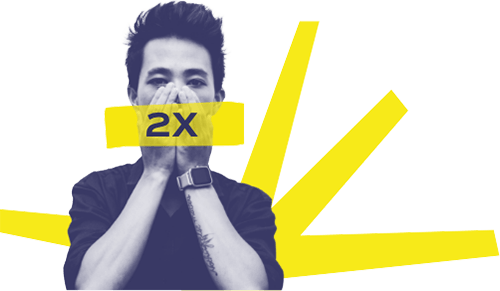
Gen Z is twice as likely as boomers to fear being fired for expressing themselves.
However, when asked if they are afraid to take certain actions for fear of some form of government punishment or retaliation, just under a third of people say they are:
- 27% say they are afraid to post controversial thoughts online.
- 26% are afraid to join political groups.
- 26% are afraid to sign up for things online.
These anxieties are most strongly held by Asian respondents, with 41% of those surveyed holding one or more of these concerns.
Assembly: the lesser known but still supported freedom
Despite protest being a common topic of news coverage this year, awareness of freedom of assembly is down with only 26% of respondents able to identify it as a freedom of the First Amendment without aid, down from 39% in 2020. Furthermore, just 3% of people say it is the most essential First Amendment right.
However, this unfamiliarity with the concept does not appear to have weakened people’s support for those who choose to assemble, including non-citizens and college students. A significant majority (89%) of respondents say that non-citizens who are studying in the U.S. who engage in legal protest should not be deported, and just over half (55%) think that deportation is appropriate for non-citizen students who actively break the law and harm someone or cause property damage.
On the other hand, one in five people (19%) surveyed believe that non-citizens who are studying in the U.S. should be deported for expressing a negative opinion of the United States.
A minority (37%) say universities should be held accountable by the government if the universities don’t punish students who engage in illegal protests, and 85% of people surveyed are aware that college students have the right to protest invited guest speakers whose political message differs from their own views.
People are also protesting more frequently this year, but protest remains one of the least-exercised freedoms overall. When asked about their activities in the past 90 days, people were much more likely to have shared a political opinion on social media (26%), signed a petition (21%) or contacted an elected official (9%) than participated in a protest (6%). This is double the protest rate in 2022 (3%) but down two points from 2020, the highest-protest year we’ve surveyed (8%).
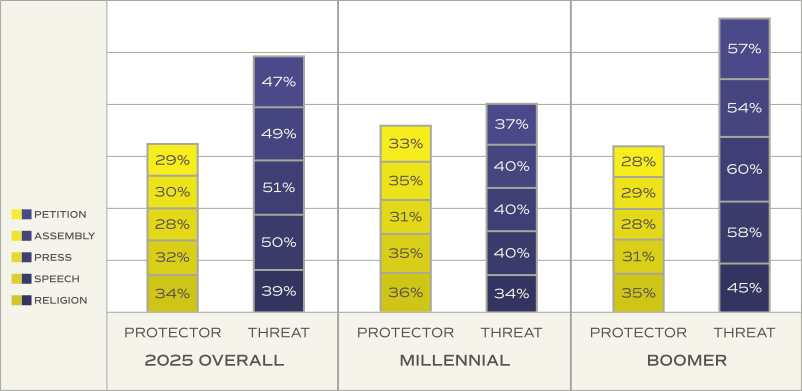
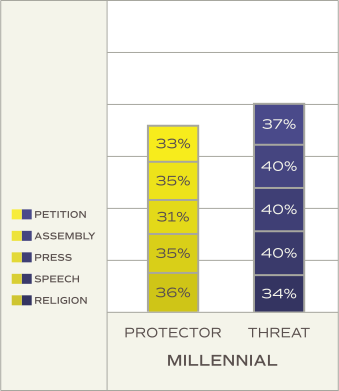
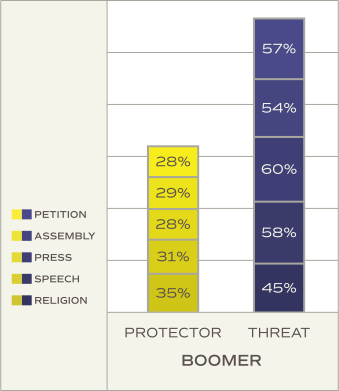
Millennials are most likely to view president trump as a first amendment protector.
President Donald Trump: protector or threat?
During the 2024 presidential campaign, we asked respondents to weigh in on which candidate was most likely to threaten or protect the First Amendment. We promised to return this year to see how people felt about the elected candidate.
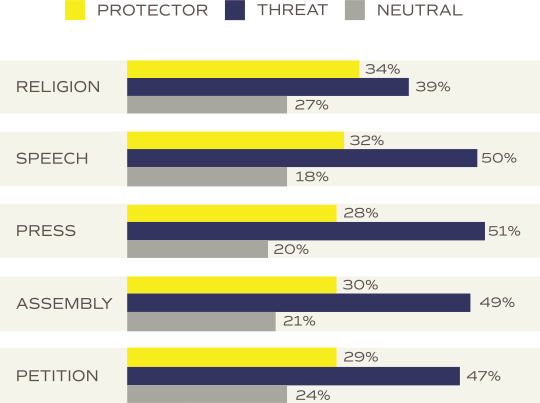
Last year, 36% of people viewed then-candidate Donald Trump as a protector of the First Amendment in general. This year, more people continue to view him more as a threat than a protector with regard to each freedom, though he was viewed as less of a threat to religion than any of the other freedoms.
Views of President trump and first amendment rights
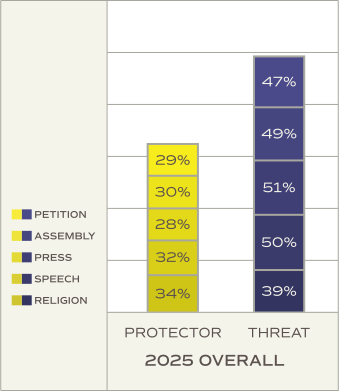
Following the same pattern as last year, President Trump has stronger support as a First Amendment protector among millennials than any other age group, with baby boomers most strongly viewing him as a threat to the First Amendment.
Views of President trump and first amendment rights by age
Who’s watching the watchdogs?
A majority (51%) of people perceive President Trump as a threat to freedom of the press. And 61% of Americans believe it’s important for the news media to act as a watchdog on government, up from 56% last year who said the press’s watchdog role was important.
However, this is a demographically divided perspective: Men (68%), Gen Xers (67%), baby boomers (69%), white (64%) and middle income (66%) respondents agree more than women (54%), Gen Z (49%), Gen Y (51%), Black (52%), and lower income (57%) respondents that it is important for the press to be a watchdog on government.
Perceptions of freedom of the press also vary in relation to new media and across generations. Nine out of 10 respondents can identify at least one information source that’s protected by the First Amendment, but people are less sure about nontraditional media: just 43% correctly identify digital video sites as protected, and 47% correctly identify social media as protected.
51% see President trump as a threat to the freedom of press.
Gen Z are overwhelmingly more likely (65%) than the average across all respondents (47%) to say that social media platforms are protected but less likely than the average to identify broadcast TV and radio (67% versus 73%) and cable news (60% versus 69%) as protected.
Nearly half of all respondents (48%) believe the government should have the power to hold social media companies responsible for false or misleading information posted to their platforms. And slightly more than half (52%) of people are concerned about being censored by artificial intelligence, suggesting growing anxieties about platforms, moderation and new technologies as they relate to free expression.
When values collide
A minority (32%) believe that preventing hate speech is more important than protecting free speech.
This is the lowest level of agreement since we first asked this question in 2020. In 2025, 38% of baby boomers favor preventing hate speech over protecting free speech, compared to 19% of Gen Z. And millennials have seen an 11-point shift since last year, with 31% agreeing today, compared to 42% in 2024.
Consistent with previous surveys, 59% of respondents say that college campuses should foster a free exchange of ideas, even if those ideas are offensive to some. Interestingly, this also scales with age: 66% of baby boomers and 60% of Gen X agree, compared to 54% of millennials and just 51% of Gen Z, the demographic most likely to be enrolled in college. Whites are more likely to say this than Black respondents (63% versus 49%).
When it comes to the intersection of religion and speech, people are somewhat more divided. When asked, “In the event they conflict with each other, which is more important to preserve?” 42% of people would choose to preserve the free exercise of religion, while 25% would prioritize preserving laws intended to prevent discrimination based on sexual orientation. One-third would take the middle ground. As with hate speech, this correlates strongly with age as baby boomers are more likely to prioritize religion (54%), compared to Gen Z and millennials (35%).
Public views on religious rights tradeoffs
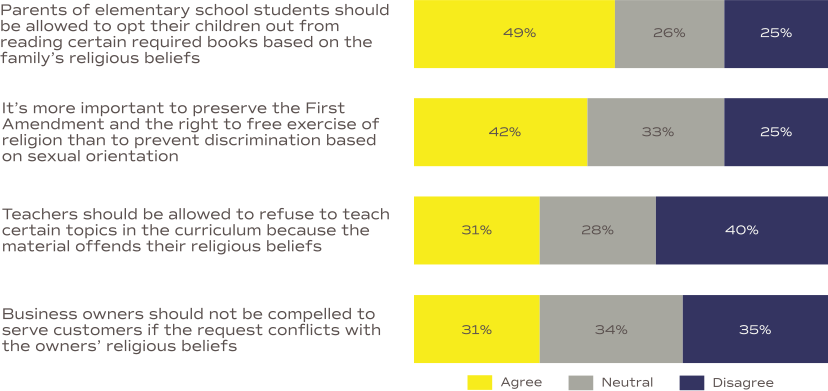
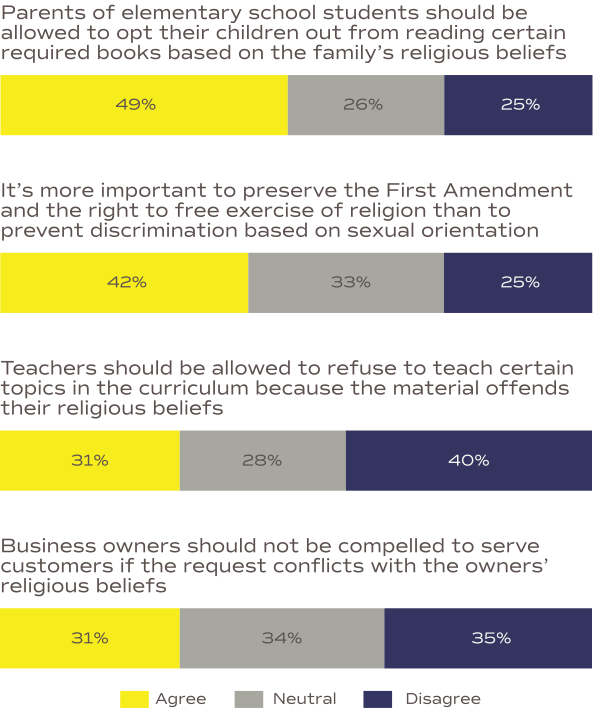
Nearly half of respondents (49%) believe that parents of elementary school students should be allowed to opt their children out of reading certain books based on their religious beliefs. But only 31% believe teachers should be allowed to opt out of teaching certain topics that offend their religious beliefs. This mirrors the 31% of people who say that business owners should not be compelled to serve customers if the request conflicts with the owners’ religious beliefs, down from 37% the first time we asked this in 2022.
The First Amendment is for everyone — but not everyone knows or values it equally
About six in 10 people (58%) agree that First Amendment rights should protect citizens and non-citizens equally. This has the strongest support among Asian (74%) and Hispanic (63%) respondents. Black respondents and white respondents are more equally divided, with each at 56%. On the other hand, one in five people (19%) surveyed believe that non-citizens who are studying in the U.S. should be deported for expressing a negative opinion of the United States.
Both general First Amendment awareness and valuing its individual freedoms frequently scale along class lines. Lower-income people have a harder time identifying unaided less popular freedoms like press, assembly and petition compared to higher-income people.
Respondents who value the first amendment
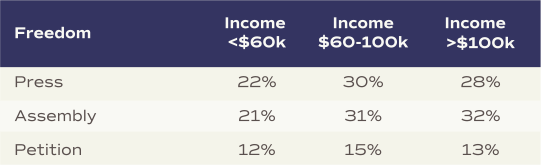
Lower-income people are also less likely to say they understand how the First Amendment affects their everyday lives (69%) compared to middle- and high-income respondents (78% and 74%, respectively).
General awareness of the First Amendment is strong, as evidenced by the 95% who have heard of it, consistent with surveys since 2020. But understanding of what precisely that entails has tapered off during the past five years, with a declining percentage of people able to identify many of the individual freedoms compared to 2020.
That’s not a cause for despair, but a call to action. The First Amendment can be learned. Misconceptions about the five freedoms and what they protect can be corrected. Since Americans overwhelmingly believe the First Amendment is vital, it is also vital to help people understand what it really protects — and why it matters to all of us.
The full survey results are available upon request. Please contact Freedom Forum Vice President and First Amendment expert Kevin Goldberg at [email protected].