
Spooky Speech: Are Halloween Decorations and Costumes Protected by the First Amendment?
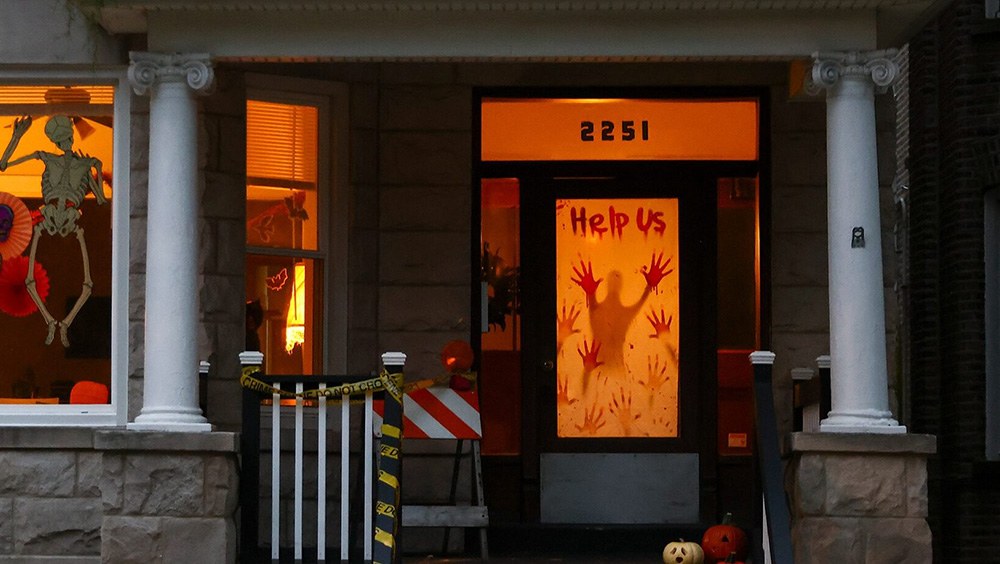
Each October, as “spooky season” begins, people around the country decorate their homes with Halloween displays — and each October 31, wear costumes — ranging from cute to creepy to controversial.
Take, for example, one Houston man whose 2025 holiday display drew strong reactions and sparked police complaints. The decor included two red-hatted mannequins hanging from gallows, flanked by coffins and a figure in Mexican attire. The owner said it was a commentary on current immigration enforcement policies and some people’s “fear of speaking [out].” Police responded that the display is First Amendment-protected free expression.
Also in October 2025, a man in Kentucky was arrested after setting up a Halloween display of five fake bodies in trash bags. The man, who had been in a dispute with the city over building permits, labeled the bags with the titles of officials like “District Judge” and “Mayor.” A law professor at the University of Louisville and a Louisville lawyer who specializes in the First Amendment agreed that while it may have been unsettling, the display was likely a form of protected political speech.
But when exactly are Halloween decorations and costumes protected by the First Amendment? And when can they be regulated?
Are Halloween decorations and costumes First Amendment-protected free speech?
Yes, the First Amendment protects expression such as displaying flags or seasonal decor, as well as clothing.
This means that the government generally cannot restrict or punish people for displaying Halloween decorations or wearing Halloween costumes — and these protections hold year-round.
Political dissent, criticism, commentary and satire receive particularly strong First Amendment protection, including when it’s in the form of Halloween decorations or costumes.
However, private companies aren’t bound by the First Amendment, so they can set their own rules about what Halloween costumes and decorations employees can wear or display. And there are exceptions when the government can regulate Halloween costumes and decoration, too.
When can the government limit or regulate Halloween decorations?
The government can regulate decorations in two main ways:
- More common — and more First Amendment-friendly — regulations limit how decorations are displayed, regardless of their message.
- When the government regulates specific decorations due to the content of those decorations, or because of the viewpoint they express, those regulations are more likely to violate the First Amendment.
When the government can limit the content of Halloween decorations
The government cannot restrict Halloween decorations simply because people find them too scary, gruesome or controversial. The First Amendment protects controversial and unpopular speech.
However, if Halloween decorations meet the legal definitions of certain unprotected speech categories, they could be restricted:
- True threats — A serious threat to commit violence or bodily harm that the speaker knew or should have known would cause them to fear for their safety
- Obscenity — Speech that is sexually explicit, patently offensive and without any other value
- Incitement to imminent lawless action — Speech that provokes the audience to immediately commit illegal activity
- Defamation — False speech that harms someone’s reputation; harder for public figures to prove than private individuals
- False light — Spreading false and highly offensive information about someone
- Intentional infliction of emotional distress — Deliberate or reckless and extreme actions or expressions that cause someone severe distress
Courts have established strict criteria for these categories because the government must limit speech as little as possible while ensuring safety. Simply being controversial or depicting violence or death isn’t sufficient reason to restrict Halloween decorations.
For example, the Houston man’s immigration display was criticized as potentially inciting violence or threatening. However, to lose First Amendment protection, officials would need to determine the display was highly likely to incite an immediate act of violence or that the creator intentionally or recklessly chose to depict specific individuals in a way that causes them to fear for their safety.

Context matters. A couple won an intentional infliction of emotional distress lawsuit against neighbors who harassed and intimidated them between 1999 and 2002 over a property-line dispute and the couple’s sexual orientation. The harassment included two mock graves facing the couple’s home. In this case, courts found that the grave display was not protected by the First Amendment because it was part of an ongoing harassment campaign toward two private people about matters not of public concern.
When the government can limit the time, place and manner of Halloween decorations
More commonly, the government limits when, where or how decorations are displayed — known as time, place and manner restrictions. These regulations are more likely to pass First Amendment muster, as they apply regardless of the message or content of the decorations and typically relate to safety.
Common time, place and manner restrictions include:
- Sound regulations — Limiting when sound effects can be played as well as their volume in residential areas
- Lighting restrictions — Setting rules for bright, flashing or strobing lights so they don’t disturb neighbors or create dangerous conditions for drivers
- Traffic safety — Ensuring decorations do not block public sidewalks or streets
- Building codes — Requiring permits and safety compliance for any structures you build
- Fire prevention — Adhering to fire safety laws
These regulations apply year-round and to all types of decor. More importantly, the government may not discriminate based on viewpoint. For instance, officials couldn’t require the Houston man to remove his display while allowing a similar display with a different message about immigration enforcement to remain.
Can an HOA or workplace limit Halloween decorations?
Yes, homeowners’ associations, apartment property managers and private workplaces can regulate Halloween decorations without violating free speech rights.
The First Amendment protects individuals from government restrictions on speech. As homeowners’ associations and landlords are private organizations, they are free to set and enforce their own rules about the exterior appearance of homes or rental units. These rules may include limits on how long decorations can be displayed, lighting colors or styles, or offensive displays.
Similarly, private businesses can tell their employees what decorations may or may not be permitted in offices and workplaces.
When can the government limit or regulate Halloween costumes?
Expressive clothing choices like Halloween costumes are generally protected as free speech. But there are circumstances when the government can regulate them.
When the government can regulate Halloween costumes in public
As with decorations, the government may limit the content of Halloween costumes if the expression falls into an unprotected speech category. For example, a costume may be considered a “true threat” if it carries a message or involves expression that constitutes a serious threat to commit violence or harm against someone; similarly, a costume may not be considered protected speech if it portrays a real person in a defamatory way or casts them in a false light.
Again, the bar for each category of unprotected speech or expression is high; being provocative, revealing, gruesome or culturally insensitive alone likely isn’t sufficient for a costume to lose First Amendment protection. The government also cannot restrict a costume due to its political or satirical message, unless it also falls into an unprotected category of speech.
For example, public colleges and universities that have tried to regulate students’ costumes that some found culturally insensitive have faced First Amendment free speech pushback for such policies.
However, government officials may restrict a costume if it contributes to an illegal activity. For example, dressing up as a police officer for Halloween is protected free speech, but attempting to pull people over or issue tickets crosses the line into impersonating law enforcement — which is a crime.
Other government restrictions related to costumes may include:
- Restrictions for safety reasons — For example, consumer protection laws prohibit the sale of children’s costumes and accessories made of flammable materials.
- Restrictions around carrying weapons, including imitation weapons that may accompany some costumes — These vary widely by state, and laws regulating the manufacture and sale of toy or imitation firearms require prominent color indicators marking them as fake weapons.
- Restrictions around mask-wearing — In some jurisdictions, it is illegal to wear a mask in some circumstances, such as to avoid being identified in public, while committing a crime or in public in general. Some have exemptions for holidays like Halloween, and some are based on age. These laws vary widely.
One frequently noted example of a costume restriction is an Alabama law that prohibits “fraudulently” dressing as a clergy member. The law has been on the books since 1965, but AL.com notes it’s unclear if it has ever been enforced. Most fraud statutes bar only impersonation with the intent to secure some specific benefit.
When the government can regulate Halloween costumes in public schools
Public school students retain free speech rights at school, but schools have broader authority to regulate speech to ensure a safe and productive learning environment. Courts have ruled that public schools may set clothing rules, which may extend to costumes, to protect health and safety and prevent disruption to education. For example, many schools do not permit hats.
If a public school student’s costume adheres to the school’s dress code, the school may not restrict it unless the costume falls into a category of unprotected speech, significantly disrupts class or infringes on other students’ rights. Public schools may not restrict a student’s costume simply because it has a political message that the school disagrees with.
Can private businesses and schools restrict Halloween costumes?
Yes. Private businesses such as restaurants, stores, malls and offices aren’t bound by the First Amendment. Neither are private schools and colleges. They are free to set their own rules for customers’, employees’ and students’ clothing. For example, some offices may allow workers to wear costumes, and others may not.
Private businesses may not treat customers differently based on a protected class, such as race, religion, sex and disability, depending on the applicable law. This, of course, includes customers wearing costumes. Otherwise, they may set their own policies around costumes, including by asking that customers not wear costumes in the establishment.
Businesses may also turn people away for costumes that they consider offensive — again, as long as it's not due to a customer being in a protected class.
And businesses that serve food may require customers to wear shirts and shoes to meet health codes, which could also affect customers’ costumes.
Similarly, private schools may have dress codes that do not permit wearing costumes.
The bottom line on Halloween costumes, decorations and free speech
Celebrating the Halloween season may involve displaying cute or creepy decor, setting up skeleton-based scenes satirizing current events, or donning delightful or dastardly costumes. And these are generally examples of First Amendment-protected free speech — unless they go too far into unprotected types of harmful speech, involve illegal activities or might be dangerous.
But remember: Private companies, HOAs, workplaces and businesses are free to set and enforce their own rules about Halloween costumes and decorations.
Karen Hansen is a content writer at Freedom Forum. She can be reached at [email protected].


Prior Restraint: When (and How) the Government Can Censor You
Related Content