
1A in Action: Mary Church Terrell and the Movement for Black and Women’s Civil Rights
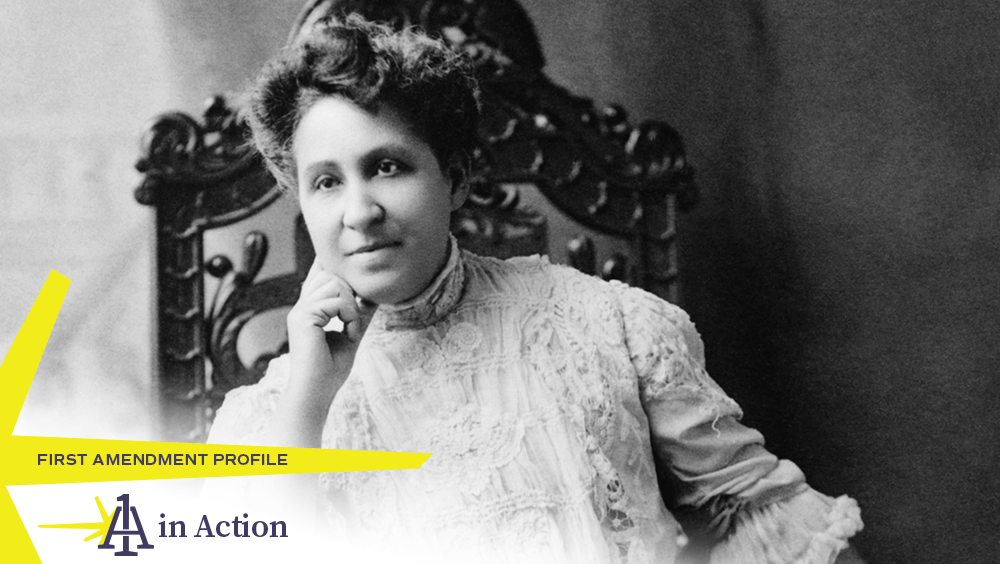
Mary Church Terrell was born during the Civil War. Her name is not always high on lists of the most recognized leaders who advanced equality for women and Black Americans — efforts that some may associate with the 20th century — but she helped build the foundations of the civil rights and women’s suffrage movements.
Forming the foundation of Terrell’s work were the First Amendment freedoms of speech, press, assembly and petition, and she used those freedoms to advocate for her beliefs and the causes she supported.
“[Mary Church Terrell] was Rosa Parks before Rosa Parks.”
— Joan Quigley, author, “Just Another Southern Town: Mary Church Terrell and the Struggle for Racial Justice in the Nation’s Capital”
Editor's note: This profile is part of 1A in Action, an ongoing series that tells the stories of the people, groups and movements that bring the five First Amendment freedoms to life every day.
From education to First Amendment-fueled activism
Terrell was born in the post-Civil War South as the daughter of formerly enslaved parents who became successful entrepreneurs. She earned undergraduate and graduate degrees from Oberlin College in Ohio and studied abroad in Europe. After graduating, she took up a teaching job at a college in Ohio before moving to Washington, D.C., in 1887, where she taught at a segregated public high school for Black students.
It was in Washington where her public life of activism and advocacy began.
In 1892, Black grocery owner Thomas Moss, Terrell’s childhood friend, was lynched by a white mob in Memphis after a dispute over the success of his business, People’s Grocery.
That spurred Terrell to publicly speak out, joining journalist Ida B. Wells in opposing lynching in the press and through organized campaigns.
Freedom of speech protects the right to speak out and express a wide range of views and ideas, and freedom of the press protects everyone’s right — not just journalists — to share those views by publishing them.
In the years that followed, Terrell continued to protest the treatment of Black Americans and organize for civil rights.
In 1906, she spoke out after President Theodore Roosevelt dishonorably discharged 167 Black soldiers under conspiracy claims in response to a shooting in Brownsville, Texas. Terrell published essays and columns advocating for a military trial to establish the soldiers’ defense, which they never received. (A 1972 military review overturned the discharges and granted the soldiers honorable discharges and back pay, though most had died by then.)
Terrell’s years of organizing also led to the 1909 founding of the NAACP, of which she was a charter member. By that time, she had already helped start and lead the National Association of Colored Women as the organization’s president from 1896 to 1901. It was through this work that her phrase “lifting as we climb” became the NACW motto.
Freedom of assembly protects the right to peacefully gather and to protest. This includes freedom of association, which protects the right to join groups, meet, organize and plan with others.
The late 19th and early 20th centuries saw Terrell advocate for women’s rights as well. Susan B. Anthony and others in the suffrage movement were protesting and petitioning for women’s voting rights. Terrell joined the cause alongside other NACW members, participating in demonstrations and picketing outside the White House to push for a constitutional amendment.
After the 19th Amendment gave women the right to vote in 1920, Terrell continued advocating for racial equality and justice. She helped organize a 1922 silent march and protest in Washington to press Congress to pass a federal anti-lynching law. Speaking about the march, Terrell said, “As I walked in silence up Pennsylvania Avenue, I thought of Tom Moss who had been brutally lynched. And I said to myself, 'there is at least one person in this protest who understands personally exactly what it means.’”
One hundred years later, in 2022, President Joe Biden signed the Emmett Till Anti-Lynching Act, defining lynching as a hate crime under federal law. This marked the first time such legislation passed Congress after decades of attempts.
Historians and scholars have attributed the passage of the law to the work of activists and organizations like Ida B. Wells, Mary Church Terrell and the NAACP.
The beginnings of the modern Civil Rights Movement
Terrell didn’t live long enough to see a federal anti-lynching law, but she witnessed, and directly contributed to, the modern Civil Rights Movement that kicked off in the 1950s.
Six years before Rosa Parks’ 1955 arrest prompted the Montgomery bus boycott, Terrell and other Washington activists formed a committee that pushed to enforce the local ordinances and end segregation in Washington restaurants and businesses. The district had passed laws prohibiting discrimination on the basis of race in the decade following the Civil War, but they were rarely followed or enforced in the 20th century.
Freedom of petition protects the right to ask the government to fix something that’s not working, such as by passing a new law, or ask to change (or not to change) a policy or practice.
Committee members tried to eat at a prominent restaurant but were refused service. They pressed Washington commissioners to sue, and in 1950, the district filed a lawsuit on the committee’s behalf, seeking to enforce the laws already in place. In 1953, the Supreme Court ruled that the district’s antidiscrimination laws were valid and enforceable, confirming the illegality of segregation in all Washington establishments (District of Columbia v. John R. Thompson Co. Inc.).
Terrell died the next year, living long enough to see her efforts help spark the broader Civil Rights Movement.
The start and end points of Terrell’s life aptly frame the First Amendment-fueled work that came between. She was born in 1863, the same year President Abraham Lincoln issued the Emancipation Proclamation.
She died in 1954, the same year the U.S. Supreme Court decided Brown v. Board of Education, holding that racial segregation in public schools is unconstitutional.
Throughout her life, Mary Church Terrell used her First Amendment freedoms of speech, press, assembly and petition to organize for change — or, to borrow her phrase, to lift others as she climbed.
Thoughts from a First Amendment expert
“The First Amendment was central to Mary Church Terrell's life's work. Even when faced with danger, she used free speech, the press and assembly as constitutional tools to fight for equality. Her actions gave underrepresented communities a voice.”
— Allison Matulli, Freedom Forum fellow for the First Amendment
Learn more
There’s a lot to learn about the freedoms of religion, speech, press, assembly and petition. And here’s much more about the First Amendment. For a list of First Amendment-related legal terms, check out this glossary. Here are more inspiring stories from the 1A in Action series.
Keep in touch
We’ll come to you. Sign up for our newsletter to get First Amendment news and resources in your inbox every week. And get in touch if you want to share a 1A in Action story of you or someone you know.
Scott A. Leadingham is a staff writer at Freedom Forum. He can be reached at [email protected].

Does the First Amendment Protect Anonymous Speech?
