
1A in Action: George Carlin and Pushing Boundaries of Comedy and Free Speech
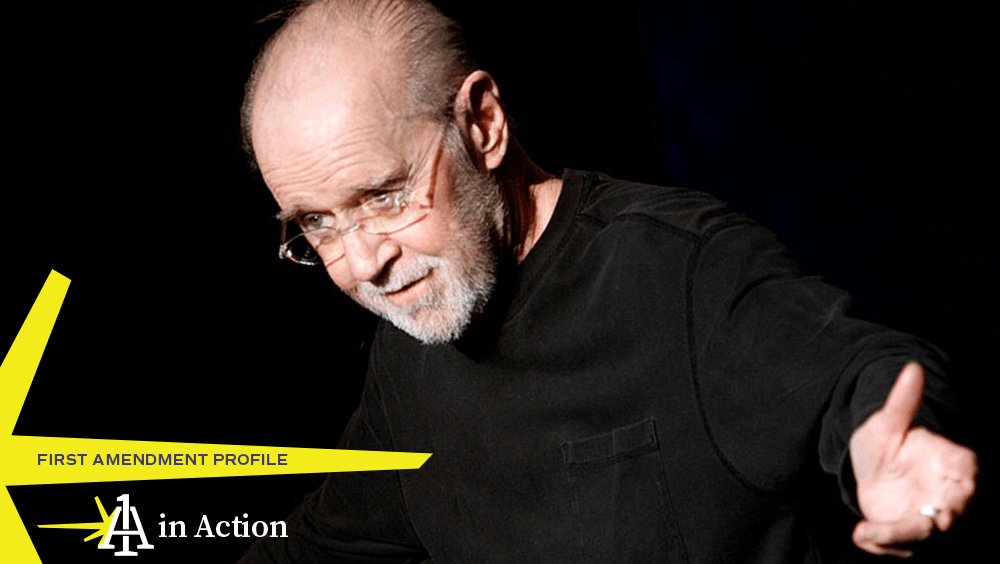
Comedy can be controversial. It often features parody or satire that critiques or criticizes, and it can be sharp, uncomfortable or offensive to some.
The First Amendment protects a wide range of comedy performances, including parody and satire. Still, those protections have limits, and comedians like George Carlin have tested them.
Carlin’s comedy career began with lighter, family-friendly routines on TV variety shows. But Carlin later said that he had gone into comedy for self-expression and that his early work wasn’t true to who he was, so he decided to take a risk and make a change.
“Self-expression is a hallmark of an artist, of art. ... And comedy, although it is not one of the fine arts — it’s a vulgar art, it’s one of the people’s arts, it’s the spoken word, the writing that goes into it is an art form,” he said in a 2008 interview.
Amid the counterculture movement of the late 1960s, Carlin began to move toward satirical social commentary. He built on his longtime love of language to study and reflect critically on how society views words, especially words that some may view as offensive.
Editor's note: This profile is part of 1A in Action, an ongoing series that tells the stories of the people, groups and movements that bring the five First Amendment freedoms to life every day.
Testing the boundaries between protected and unprotected speech
Carlin’s evolving style was also influenced by fellow comedian Lenny Bruce, who was arrested and prosecuted for obscenity several times for his comedy act. One such instance occurred in Chicago in 1962, when Carlin was in the audience. The Illinois Supreme Court later said Bruce’s routine was not obscene, reversing an earlier ruling in light of new U.S. Supreme Court guidance.
"[Lenny Bruce’s work] let me know that there was a place to go, to reach for, in terms of honesty in self-expression."
"My Comedian Hero: George Carlin,” PBS (2009)
Like Bruce, Carlin’s work pushed the courts to further consider questions around free speech.
At a July 1972 live standup show in Milwaukee, Carlin performed a routine called “Seven Words You Can Never Say on Television” featuring the vulgarities he identified. He was arrested immediately after performing the routine and charged with disorderly conduct on the grounds that the routine was offensive and likely to cause disruption among the audience.
A judge dismissed the charges, saying the language may have been indecent, but it was not legally obscene, and that, based on the eyewitness account of an assistant district attorney who happened to attend the performance, Carlin had not created a disturbance.
Obscenity, indecency and First Amendment protection
There are several categories of speech that are not protected by the First Amendment, although these are defined narrowly to protect as much speech as possible.
One area of unprotected speech is obscenity.
A related but distinct category of speech is indecency, which is generally protected by the First Amendment but may be more heavily regulated in certain contexts, especially broadcast media.
Carlin’s bit about dirty words questioned the unclear boundaries around broadcast rules. Soon, his own act would test the limits of the Federal Communications Commission’s authority to regulate language on broadcast media.
The FCC and Supreme Court weigh in
The following year, a separate but similar routine of Carlin’s, known as “Filthy Words,” became the subject of a legal dispute. In October 1973, as part of a broadcast about attitudes toward language, New York City radio station WBAI aired a recording of the “Filthy Words” routine. A man listening to the radio in the car with his young son complained to the FCC.
The FCC found that broadcasting the “Filthy Words” routine violated its indecency rules. According to the FCC, the routine’s language was not legally obscene, but it was indecent, in part because it was “patently offensive,” one of the factors the FCC considers in determining indecency.
The case reached the Supreme Court, where the Pacifica Foundation, the owner of WBAI, argued that the FCC’s indecency rules violated the First Amendment and laws against censorship, claiming the rules were “overbroad” and that Carlin’s routine did not meet the definition of “indecent.”
"Now everyone is walking around wondering what they can say and censoring themselves, and, as a result, lowering the standards of discussion and thought."
"George Carlin's American Dream," HBO (2022)
But in 1978, the Supreme Court ruled 5-4 that the FCC has the authority to impose limited civil penalties on over-the-air broadcast stations that air indecent content during hours when children are likely listening and that “there is no basis for disagreeing with the Commission’s conclusion that indecent language was used in this broadcast.”
The FCC’s authority to restrict broadcast media
The Communications Act empowers the FCC to regulate broadcasters to ensure they operate in the public’s interest. For example, the FCC can regulate indecent content in ways the First Amendment wouldn’t allow for other media. And obscenity is never protected.
Carlin later commented about the case, “It’s never good news when the First Amendment has been chipped away a little bit. … Should these words have this power over us?”
Carlin’s legacy and the First Amendment
Carlin’s comedy routines contributed to the larger conversation among the government, media and the public about the extent to which society legally permits and limits speech — and his work left an impact.
He was awarded the American Comedy Awards Lifetime Achievement Award in 2001 and the Mark Twain Prize for American Humor in 2008. He won the Grammy Award for Best Comedy Album five times.
By going to extremes in his comedy routine, Carlin created an opportunity to refine the lines between free speech, unprotected speech and speech that is protected but that can be limited.
Broadcast radio and TV regulation still relies on the lines drawn in the 1978 Supreme Court case over his radio routine, and stations still use the “Carlin Warning” to remind performers of what not to say during live daytime broadcasts.
As Freedom Forum Fellow for the First Amendment David L. Hudson Jr. said:
“Carlin’s ‘Filthy Words’ monologue led to a most important U.S. Supreme Court First Amendment decision on the regulation of broadcast indecency. But beyond that, he was a profoundly important comedian and social satirist, which made him a First Amendment hero to many. If one listened to George Carlin, one heard an important cultural and social voice who often spoke out against censorship.”
Learn more
There’s a lot more to learn about the freedoms of religion, speech, press, assembly and petition. Here’s more about the freedom of speech and some of its limits. And here’s much more about the First Amendment. For a list of First Amendment-related legal terms, check out this glossary.
Keep in touch
We’ll come to you. Sign up for our newsletter to get First Amendment news and resources in your inbox every week. And get in touch if you want to share a 1A in Action story about you or someone you know.
Karen Hansen is a staff writer at Freedom Forum. She can be reached at [email protected].

Perspective: Let public opinion, not the Supreme Court, curb social media companies

Is the Government Watching You? Surveillance and the First Amendment, Explained
Related Content