
1A in Action: Frank Kameny and the Fight Against Employment Discrimination
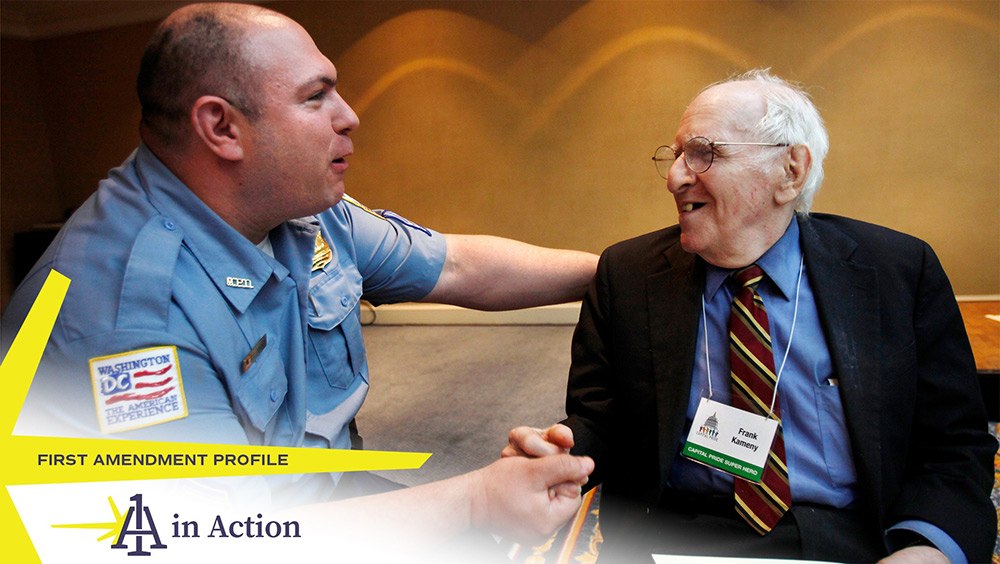
Frank Kameny fought for his country during World War II. And he fought for his job at home.
In the U.S., the modern LGBTQ+ movement, like many causes, is built on decades of activism and advocacy fueled by people like Kameny exercising their First Amendment rights.
After the war, Kameny, a longtime Washington, D.C., resident, returned from fighting in Europe, earned a doctorate in astronomy at Harvard University, and worked in the federal civil service. Then, in 1957, amid the so-called “Lavendar Scare” of the mid-20th century, he was fired — and banned from all federal jobs — after the U.S. Civil Service Commission learned he might be gay.
His firing sparked a decades-long career advocating for equal treatment of LGBTQ+ people and for the right to think and believe freely — exercising his First Amendment rights as he protested outside the White House, petitioned the U.S. Supreme Court, and co-founded the D.C. chapter of the Mattachine Society, a gay rights group. Kameny also went on to be the first openly gay man to testify before Congress and later became the first openly gay man to run for Congress.
Editor's note: This profile is part of 1A in Action, an ongoing series that tells the stories of the people, groups and movements that bring the five First Amendment freedoms to life every day.
What was at stake:
Federal law prevents discrimination in hiring and firing people in most jobs (with some exceptions) over sexual orientation and other things such as faith, race and national origin. But that law didn’t exist when Kameny and others thought to be gay were fired from their government jobs during the Lavender Scare.
Today, many workers are protected from employment discrimination in ways that didn’t exist 60 years ago — because those who were fired spoke out, protested and demanded change. Kameny and others used their First Amendment rights of religion, speech, press, assembly and petition to push for changes in federal and state employment laws.

What happened:
Although many others shared his fate at the time, Kameny responded in court, seeking to be reinstated to his federal government job after being fired for his sexual orientation. When the lower federal courts rejected his claim, Kameny filed a petition to the U.S. Supreme Court on his own.
Kameny was not only exercising his First Amendment right to petition; he grounded his legal argument in the First Amendment. Kameny argued that the government’s exclusion of gay people from federal jobs suppressed freedom of belief and imposed moral standards on employees. He called it an attempt by the state to dictate how citizens should think and believe, violating the First Amendment — an argument unheard of at the time in this context.
The Supreme Court declined to hear his case, but Kameny continued to lead public marches and write letters to elected officials, including President John F. Kennedy. He distributed buttons with pro-LGBTQ+ rights messages from his personal collection. Kameny is credited with the term “Gay is Good,” seen on many of his protest signs of the 1960s and beyond.
He and others successfully pushed the American Psychiatric Association to remove homosexuality from its list of mental illnesses. In 2009, President Barack Obama recognized Kameny’s advocacy for LGBTQ+ rights in an Oval Office ceremony, and the U.S. government formally apologized for firing him 50 years earlier.
Kameny died in 2011 at age 86. A D.C. street was named in his honor a year earlier during the city’s annual Pride celebration. The date of his death, Oct. 11, has additional significance: It’s the same date as National Coming Out Day.
What Frank Kameny said:
“In World War II, I willingly fought the Germans, with bullets, in order to preserve and secure my rights, freedoms, and liberties, and those of my fellow citizens. In 1961, it has, ironically, become necessary for me to fight my own government, with words, in order to achieve some of the very same rights, freedoms, and liberties for which I placed my life in jeopardy in 1945.”
— Frank Kameny in a letter to President John F. Kennedy
Why it matters to you:
The First Amendment means you can speak out, protest and petition the government for change. It also protects your freedom of religion — which includes your right to hold and exercise your deepest beliefs — and to think differently, live openly and dissent.
However, the right to petition doesn’t mean courts automatically change laws or policies. It can take people using their voices to advocate for a cause — as Kameny did — for government officials, including courts, to act.
In other words: The First Amendment is there for you, the people, to use.
Frank Kameny’s inspiration:
“If society calls homosexuality a sickness (and it does), then the entire validity of our entire position, of our demands for equality, of everything for which we stand rests upon our responding to that sickness with a denial.”
— Frank Kameny in a 1962 letter to a fellow LGBTQ+ rights activist
Thoughts from a First Amendment expert:
“In recent years, we have seen a wave of lawsuits that seek to limit the reach of antidiscrimination laws that purportedly abridge free speech or prohibit the free exercise of religion. As a result, some Americans have begun to ask whether the First Amendment is a barrier to equality. But Frank Kameny's story reminds me why those who are most marginalized — those who are denied equal liberty — need the First Amendment. His advocacy was made possible by the five freedoms of the First Amendment, and I hope he inspires us to recommit ourselves to exercising those same freedoms to demand a more just world for all.”
— Benjamin P. Marcus, Freedom Forum Fellow for Religious Freedom
Learn more:
There’s a lot to learn about freedom of speech, assembly and the First Amendment. Here’s more about the freedom of speech and some of its limits. Here’s more on the freedom of assembly. And here’s much more about the First Amendment. For a list of First Amendment-related legal terms, check out this glossary.
Keep in touch:
We’ll come to you. Sign up for our newsletter to get First Amendment news and resources in your inbox every week. And get in touch if you want to share a 1A in Action story of you or someone you know.
Scott A. Leadingham is a content writer at Freedom Forum. He can be reached at [email protected].

Perspective: Why Arguments for Regulating Social Media Fail the First Amendment Test
Sacred Spaces Threatened: 3 Times Places of Worship Faced Barriers
Related Content