
Recording Law Enforcement: First Amendment Right or Arrestable Offense?
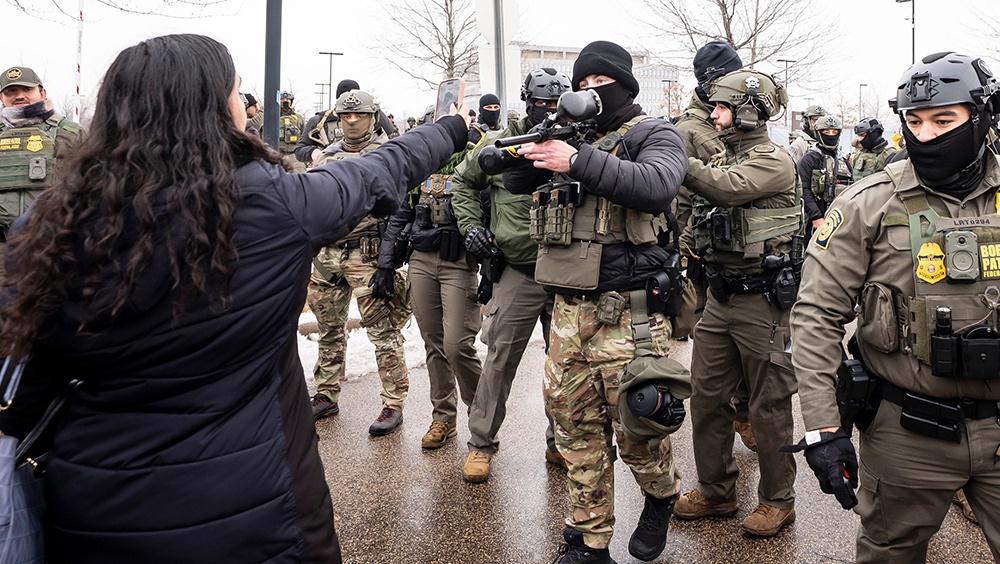
Courts have recognized that First Amendment rights generally protect people when recording law enforcement who are on duty and in a public area — in photos, video or audio. But there are limits on when, where and how.
Today’s mobile devices often mean people are recording when law enforcement activity is beginning or underway, sometimes producing conflicts with authorities.
In this post, we take a deep dive into recording law enforcement officers — which extends beyond police officers to include anyone who has the power to act on behalf of a local, state or federal government in order to maintain public order and safety by preventing, investigating and prosecuting crimes. We explore when you can (and can't) film law enforcement, what the courts have said, and more.
Is it legal to record law enforcement?
Courts have protected a general right to record law enforcement when the officers are performing official actions in a public space, such as a street or park. This right is protected under both freedom of speech as free expression and freedom of the press, which includes protection for gathering information about the government and for sharing it with others.
If law enforcement officers are inside your home, you have a right to record them, but you are subject to the same limits as outside.

Are there times law enforcement cannot be recorded?
There are a host of cautionary things to consider. Courts have said recording law enforcement can be limited or prohibited when:
- Interfering with official duties: Courts often defer to law enforcement judgment over on-the-spot decisions in cases when recording interferes with officers’ official duties. But that deference is not a “blank check”: Prosecutors would have to prove the person intended to interfere or reasonably should have known they were interfering with law enforcement based on the circumstances — and the person doing the recording will be able to present evidence this was not the case.
- Ensuring public safety: Law enforcement officers can set reasonable conditions, such as the distance the public must stand back, in the name of public safety or to prevent damage to a crime scene.
- Preventing trespassing: Courts may prohibit recording that involves the public entering private property, even when the person making the recording is immediately following law enforcement officers, or when someone records without permission inside police stations and jails.
- Preserving privacy rights: Recording can be limited if it violates privacy rights, such as through the use of technology to make audio or video recordings inside a private residence. Generally, with very limited exceptions, there are no claims to privacy rights in public spaces.
- Prohibiting criminal activity: Recording may be prohibited if law enforcement officers have reasonable grounds to believe the act of recording itself is inciting violence or encouraging others to commit a crime, such as inciting a mob or encouraging a person being arrested to resist or attack police.
Some courts also have found recording to be illegal when the aim is to expose certain legally justified law enforcement activities that are sensitive in nature and would be jeopardized if made public, such as surveillance of a criminal suspect or a court-approved undercover operation.
Recording the regular activity of law enforcement officers, such as how and when an officer regularly leaves home to go to work, may be judged to be “stalking” or intimidation. And some states have laws banning the recording of private conversations without the permission of one or all of the people involved, regardless of location or if law enforcement officers are involved.
There are different restrictions in some states on recording audio — which apply to the audio heard in a video recording. Several states, for example, require either permission from others being recorded (so-called “two-party” states) or notification that a recording is being made.

Some states have also enacted or considered "police buffer zones": distances that people must stand away from police activities, including when recording. These include Louisiana, Indiana and Florida.
What do the courts say about recording law enforcement?
While the U.S. Supreme Court has not ruled directly on a citizen’s right to record law enforcement, in the 1972 case Branzburg v. Hayes, Supreme Court justices said that “without some protection for seeking out the news, freedom of the press could be eviscerated.” This has been interpreted to include recording law enforcement.
A number of federal appellate courts have upheld a right to record law enforcement, citing the First Amendment and the necessity to hold authorities accountable.
For example, in 2022, a U.S. Court of Appeals for the 10th Circuit held in Irizarry v. Yehia that “filming the police and other public officials as they perform their official duties acts as ‘a watchdog of government activity’” and is a constitutional right.
Law enforcement officers may legally confiscate a person’s recording device when arresting them or when serving a subpoena or search warrant that covers their phone. But officers cannot search your phone without a warrant, or order you to delete photos, video or audio. Without specific court orders to the contrary, the authorities may only possess your phone for administrative purposes, such as storage of personal possessions taken when a person is arrested.
In Riley v. California (2014), the U.S. Supreme Court said police need court approval to search the contents of a phone seized during arrest. Chief Justice John Roberts wrote:
“Modern cell phones are not just another technological convenience. With all they contain and all they may reveal, they hold for many Americans ‘the privacies of life.’ The fact that technology now allows an individual to carry such information in his hand does not make the information any less worthy of the protection for which the Founders fought. Our answer to the question of what police must do before searching a cell phone seized incident to an arrest is accordingly simple — get a warrant.”
Gene Policinski is a senior fellow for the First Amendment at Freedom Forum. He can be reached at [email protected].
This information is intended solely for educational purposes. It is not intended to serve as legal advice or as a substitute for professional counsel.
Celebrating the Power of Music and the First Amendment at Freely Fest
Where America Stands on the First Amendment: By the Numbers
Related Content