
15 Freedom of the Press Quotes You Should Know
Press freedom is a core part of the First Amendment, along with the freedoms of religion, speech, assembly and petition. It’s also not reserved only for journalists working at certain kinds of news outlets; press freedom applies to everyone.
At the time the First Amendment became part of the U.S. Constitution in 1791, “the press” was limited to the technology of the day: printed newsletters, newspapers and pamphlets. But the First Amendment's protections for press freedoms include the gathering, producing and sharing of content through any medium available. Today, press freedom in the United States means all forms of media, from podcasts to digital newsletters to streaming video.
To pay tribute to this important right, we assembled 18 freedom of the press quotes to inspire and inform you.
Discover freedom of the press quotes from throughout history
John Adams, Samuel Adams and James Bowdoin
“The liberty of the press is essential to the security of freedom in a state: it ought not, therefore, to be restrained in this commonwealth.” – John Adams, Samuel Adams, James Bowdoin, Constitution of the Commonwealth of Massachusetts
This line from the Massachusetts Constitution, written by the Adams cousins and Bowdoin in 1779, helped inform the First Amendment’s press freedom protection written 10 years later.
Hannah Arendt
“The moment we no longer have a free press, anything can happen. What makes it possible for a totalitarian or any other dictatorship to rule is that people are not informed. … If everybody always lies to you, the consequence is not that you believe the lies, but rather that nobody believes anything any longer.” — Hannah Arendt, political theorist
Arendt looked at how power and totalitarianism work together. She said this in a 1974 interview that was published in 1978 by The New York Review of Books.
Hugo Black
“In the First Amendment, the Founding Fathers gave the free press the protection it must have to fulfill its essential role in our democracy. The press was to serve the governed, not the governors. The government’s power to censor the press was abolished so that the press would remain forever free to censure the government. The press was protected so that it could bare the secrets of government and inform the people.” — Hugo Black, U.S. Supreme Court justice
Writing an opinion in the 1971 case New York Times Co. v. United States, Black wrote of how important it was to uphold press freedom when the government attempted to block publishing of the Pentagon Papers.
Sir William Blackstone
“The liberty of the press is indeed essential to the nature of a free state. … To subject the press to the restrictive power of a licenser as was formerly done, both before and since the revolution, is to subject all freedom of sentiment to the prejudices of one man, and make him the arbitrary and infallible judge of all controverted points in learning, religion, and government.” — William Blackstone, 18th century British jurist
This comes from Blackstone’s “Commentaries on the Laws of England 1765-1769.”
President George W. Bush
“Power can be very addictive. And it can be corrosive. And it's important for the media to call to account people who abuse their power.” — George W. Bush
All presidents have a touchy relationship with the press, including Bush, who clashed with journalists many times during his eight years in office. He said this in a February 2017 NBC interview where he called the news media “indispensable to democracy.”
Albert Camus
“A free press can, of course, be both good and bad, but, most certainly, without freedom, the press will never be anything but bad.” — Albert Camus, French author
The 1957 Nobel Prize winner for literature said this in a 1955 speech titled “Homage to an Exile,” the text of which was collected in a book of his essays, “Resistance, Rebellion, and Death.”
Miloš Forman
“The cornerstone of democracy is free press – that's the cornerstone. I'm convinced if the press ... it was not possible, of course, but if the free press existed through this century, there wouldn't be Hitler there wouldn't be Stalin, there wouldn't be all this incredible price people have to pay for their freedom.” — Miloš Forman, film director and screenwriter
The Oscar-winning director, known for “One Flew Over the Cuckoo’s Nest” and “Amadeus,” said this during a 1997 interview with the National Security Archive.
Massimo Introvigne
“A free press is a press capable of recognizing that its real freedom comes from its commitment to the truth. We need media brave enough to tell the truth even when this truth is unpopular, or disturbs the powers that be, as it often happens when religious or spiritual minorities are persecuted.” — Massimo Introvigne, Italian sociologist and founder of the Center for Studies on New Religions
Introvigne wrote that in 2023 for World Press Freedom Day, remembering the murder of Catholic priest and journalist Maximilian Kolbe at the Auschwitz concentration camp in 1941.
Thomas Jefferson
“Our liberty depends on the freedom of the press, and that cannot be limited without being lost.” — Thomas Jefferson
Jefferson wrote this in a letter to James Currie in 1786. He is also famously and often quoted as saying:
“The basis of our governments being the opinion of the people, the very first object should be to keep that right; and were it left to me to decide whether we should have a government without newspapers or newspapers without a government, I should not hesitate a moment to prefer the latter.” — Thomas Jefferson
But Jefferson’s ringing endorsement of newspapers in a 1787 letter is tempered by quotes from later in his life that suggest his view had changed during and after his presidency, given a tumultuous relationship with the press.
“Nothing can now be believed which is seen in a newspaper. Truth itself becomes suspicious by being put into that polluted vehicle.”
“From 40 years experience of the wretched guesswork of the newspapers of what is not done in open day light, and of their falsehood even as to that, I rarely think them worth reading, and almost never worth notice.”
Jefferson wrote those in separate letters, in 1807 and 1816, respectively.
Nikole Hannah-Jones
“There’s a reason why the First Amendment to the Constitution protects a free press, because we play a unparalleled role in a democracy, in a free society, and that’s not something that I take lightly.” — Nikole Hannah-Jones, journalist and Howard University Knight Chair in Race and Journalism
Hannah-Jones said that in a 2024 interview with the Poynter Institute. She also spoke about the role of the press and her experiences of backlash to her 1619 Project work at The New York Times as an honoree of Freedom Forum’s 2022 Free Expression Awards.
President John F. Kennedy
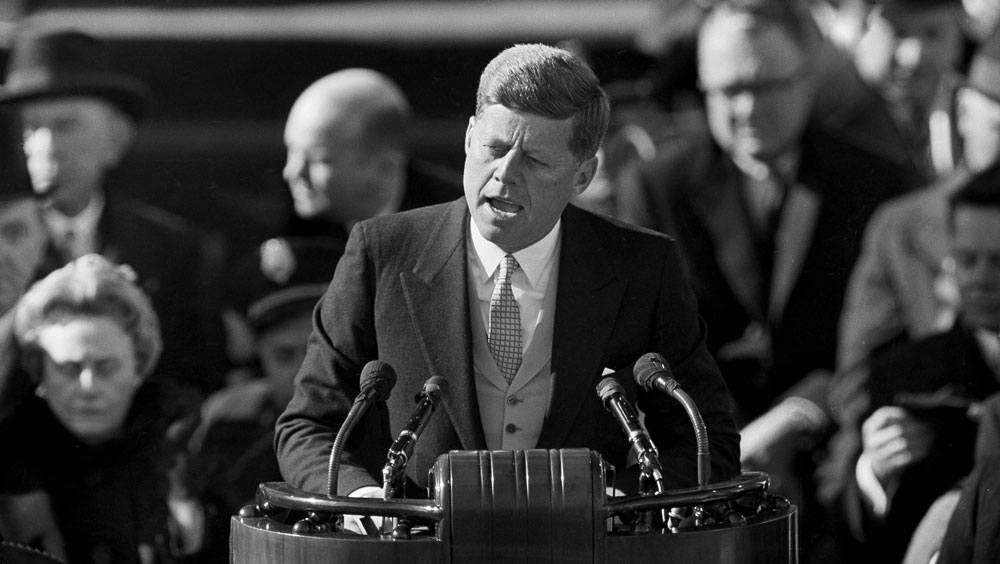
“Without debate, without criticism, no administration and no country can succeed — and no republic can survive. ... And that is why our press was protected by the First Amendment – the only business in America specifically protected by the Constitution – not primarily to amuse and entertain, not to emphasize the trivial and the sentimental, not to simply ‘give the public what it wants’ — but to inform, to arouse, to reflect, to state our dangers and our opportunities, to indicate our crises and our choices, to lead, mold, educate and sometimes even anger public opinion.” — John F. Kennedy
This comes from a 1961 speech Kennedy gave before the National Newspaper Publishers Association.
The Rev. Martin Luther King Jr.
"But somewhere I read of the freedom of assembly. Somewhere I read of the freedom of speech. Somewhere I read of the freedom of press. Somewhere I read that the greatness of America is the right to protest for right." ― The Rev. Martin Luther King Jr.
This line invoking the First Amendment during protests supporting striking sanitation workers in Memphis, Tenn., comes from King’s famed “I’ve Been to the Mountaintop” speech on April 3, 1968, given the night before he was assassinated.
John McCain
“We need a free press. We must have it. It's vital. … if you want to preserve democracy as we know it, you have to have a free and many times adversarial press. And without it, I am afraid that we would lose so much of our individual liberties over time. That's how dictators get started. They get started by suppressing free press.” — John McCain, former U.S. Senator
McCain built his reputation on being a “straight shooter” during his two runs for president in 2000 and 2008. He said this defense of press freedom in 2017, one month after President Donald Trump was inaugurated, in response to Trump calling journalists “the enemy of the American people.” McCain died the next year.
George Orwell
“Freedom of the press, if it means anything at all, means the freedom to criticize and oppose.” — George Orwell, author
Orwell wrote this in 1946 as part of larger essay called “The Prevention of Literature” about free expression and his opposition to the totalitarian government in Soviet Russia.
Ida B. Wells
“The assertion has been substantiated throughout these pages that the press contains unreliable and doctored reports of lynchings, and one of the most necessary things for the race to do is to get these facts before the public. The people must know before they can act, and there is no educator to compare with the press.” — Ida B. Wells, investigative journalist and Black civil rights activist
Wells penned this in 1892, later collected in a book about her work, “Southern Horrors and Other Writings.” Her work documented the brutality of lynchings of Black Americans in the post-Civil War era.
Scott A. Leadingham is a content writer at Freedom Forum. He can be reached at [email protected].
These quotes were compiled with contributions from by Freedom Forum Research and Library Director Rick Mastroianni.

1A in Action: 12 LGBTQ+ Activists Who Used the Power of the First Amendment

Sign of the Times: When, Where and How Political Signs Can Be Restricted
Related Content
You have the right to express yourself IRL.
