
Florida orders cities to erase street art, sparking free speech debate
This article was originally published in the Tallahassee Democrat as part of the First Amendment Reporters initiative, which is made possible by a collaboration among Freedom Forum, Journalism Funding Partners and the USA TODAY Network. Freedom Forum and JFP did not provide editorial input.
The state is telling Florida cities to strip the paint off their streets, but these orders from Gov. Ron DeSantis' administration hint at a First Amendment gray area:
Is art in street crosswalks political speech?
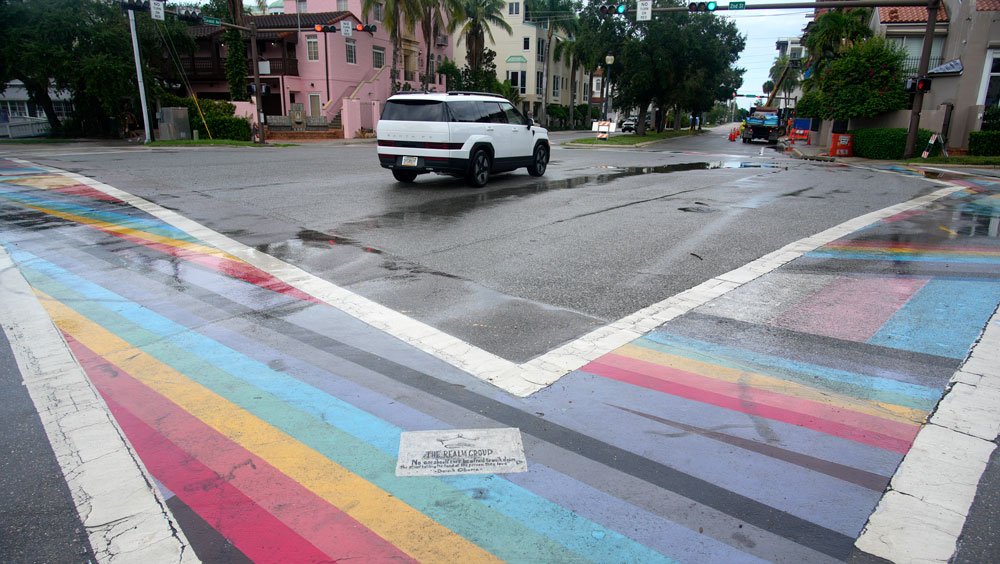
All types of road art has been targeted in this overhaul: Street murals, rainbow crosswalks, even "Back the Blue" street art in Tampa supporting police.
Removing art in one particular Orlando crosswalk drew national attention: Florida state transportation employees painted over a rainbow crosswalk, on the road since 2017, memorializing 49 lives lost by a gunman who opened fire at Pulse, an LGBTQ+ nightclub.
The move by state officials to remove street art comes at a time where federal officials are mounting pressure to remove political murals from roadways. U.S. Transportation Secretary Sean Duffy remarked in early July, “Taxpayers expect their dollars to fund safe streets, not rainbow crosswalks.”
Yet what's important in the coming weeks is how the state continues to apply its order to remove street art, since the First Amendment requires the government to enforce its orders neutrally to favored or opposing viewpoints.
The Pulse shooting is one of the nation’s deadliest mass shootings, and the crosswalk’s removal evoked outrage and despair from Orlando locals and officials. DeSantis’ response, however, to one representative’s social media post: “We will not allow our state roads to be commandeered for political purposes.”
Crosswalk art not political statement, Orlando mayor says
On Aug. 27, Orlando Mayor Buddy Dyer asked the state to make an exception.
“The Original Design was not intended to be, nor do we believe it to be any form of political speech, nor does it include any words or messages or symbols,” Dyer wrote to the Florida Department of Transportation.
“The Pulse Crosswalk was located where the attacks occurred, and was part of an ongoing memorial to remember and pay homage to the victims.”
In Dyer’s letter, he said the crosswalk didn’t interfere with traffic control devices and that it complied with the state’s adopted crosswalk standards, by having the rainbow color in between the “white thermoplastic lines” that signify a crosswalk to pedestrians and drivers.
Moreover, he noted that since its installation, there hasn’t been a single pedestrian accident at that intersection.
Are rainbow crosswalks inherently political?
In courts, LGBTQ+ issues are considered political because they're “something that is publicly contested,” said Maru Smith-Opabola, a teaching and research fellow focused on the First Amendment at the University of Florida Levin College of Law. Under that notion, rainbow crosswalks would qualify under political speech.
Smith-Opabola said if the government specifically said they were removing rainbow art and removed LGBTQ+ murals across the state, that wouldn’t be viewpoint neutral — a legal doctrine in First Amendment law that a regulation doesn’t discriminate against one particular viewpoint.
In Florida, state directives have applied to all street art, including murals painted outside school crosswalks, a street mural painted by pro-police activists in Tampa and rainbow crosswalks across the state in solidarity with LGBTQ+ communities.
It’s unclear exactly how many rainbow crosswalks exist throughout Florida, but multiple rainbow crosswalks in various cities like Gainesville, Orlando and West Palm Beach have already been painted over or other removed. Some erasures are pending with deadlines by early September, such as Key West and Miami Beach.
Is crosswalk art free expression protected from the government?
Courts haven’t definitively protected crosswalks or asphalt art in First Amendment cases, but roadways have traditionally been a public forum for protests and expression, Smith-Opabola said.
“The public may be able to expect to use public sidewalks for speech or protest, because that's a historical use of streets and sidewalks,” Smith-Opabola said. “But using them for visual art that you would like to be able to leave there has not been a historically protected expression, and I don’t think I’ve seen any case law yet that would declare it that.”
The Free Speech Center at Middle Tennessee State University wrote Aug. 21 that asphalt art was "clearly political speech." But it noted that the state has the right to pick and choose what viewpoints it favors, as long as it applies these laws neutrally when enforcing it.
"This being said, if governments ban groups from painting pro-LGBTQ or pro-Black Lives Matter asphalt art on public streets, the doctrine of content neutrality would likely also prevent it from supporting anti-LGBTQ or anti-Black Lives Matter art as well," wrote John Vile, a political science professor at the university.
How states across the country plan to implement these orders still remains significant to the First Amendment, because it could mean a constitutional violation if municipalities remove one viewpoint over another in these expressive art forms.
University of Central Florida political science professor Aubrey Jewett said that this move seemed like a further escalation of removing anything "LGBTQ+ related" from the public.
The DeSantis administration in recent years put restrictions on discussion gender and sexuality in schools, including prohibiting teachers from using preferred pronouns.
In addition, some school districts previously interpreted a law that prevents books in schools describing "sexual conduct" as meant to remove books with LGBTQ+ themes or characters.
"Even though the motive behind this seems to be to go after the rainbow crosswalks, I think they realize that if they did that, they would probably be very vulnerable to a court challenge that brings First Amendment questions," Jewett said.
What is the state transportation department saying?
In a press conference about two miles from where the Pulse shooting's memorial crosswalk was painted over, Gov. Ron DeSantis defended the state's stance on street art, saying the Florida Legislature passed a law disallowing it recently.
"I think the street art got out of hand," DeSantis said. "I think it's much better that we use crosswalks and streets for their intended purpose."
In late June, the Florida Department of Transportation sent a letter highlighting a portion of Florida law requiring traffic control devices, which include pavement surface markings, are compliant with department standards. This law was amended through through legislation (SB 1662) and signed by the governor in March.
The FDOT letter said noncompliant pavement markings includes art that is "associated with social, political, or ideological messages or images and does not serve the purpose of traffic control." It threatened that failure to remove noncompliant markings would result in withheld state funds.
This reporting content is supported by a partnership with Freedom Forum and Journalism Funding Partners. USA Today Network-Florida First Amendment reporter Stephany Matat is based in Tallahassee, Fla. She can be reached at [email protected]. On X: @stephanymatat.

20 of the Most Famous Protests in US History

When Private Information Becomes Public: What Is Public Disclosure of Private Facts?
Related Content