
From Comedic to Controversial: 11 of the Most Famous Political Cartoons in US History

Cartoons — a form of free speech and free press protected by the First Amendment — often recall humor and laughter. But they have also long been used for political commentary.
Before there was a United States of America, there were now-famous political cartoons being printed in pamphlets and distributed to spread the cartoonists’ and publishers’ views on civic matters. Benjamin Franklin used cartoons in his various publications to show support for and against government policies or to influence public opinion.
But like all First Amendment freedoms, the right to publish whatever cartoons you want is limited.
The government could punish the publication of cartoons if they fall into an unprotected category of speech such as defamation, obscenity, invasion of privacy or intentional infliction of emotional distress. Restricting publication outright (known as a prior restraint) is also a possibility, but a highly unlikely one, as it would generally require that the cartoon put human lives in harm’s way.
In reality, government punishment of political cartoons is rare due to the strong protection the First Amendment gives to works of parody and satire. However, because the First Amendment applies only to government action to block publication, and not to privately owned newspapers or magazines, a publisher or editor could change or completely block any cartoon they don’t like.
Discover 11 famous political cartoons
For more than 200 years, political cartoons have inspired people in the U.S. to think, react and participate in their democracy. They have also stirred debate over what they depict, who they criticize, and how government officials or the public react.
Here are famous political cartoons that used the power of the First Amendment to criticize, editorialize and dissent.
Editor’s note: These cartoons are listed in chronological order.
Benjamin Franklin: “Join, or Die” (1754)
As publisher of the Pennsylvania Gazette and a delegate to an upcoming gathering of colonial representatives, Benjamin Franklin published the “Join, or Die” cartoon to encourage more coordination among the American colonies. At the time, it wasn’t British influence Franklin was worried about, but the incursion of French military forces into the colonies. Versions of the snake cut into various pieces to symbolize the need to band together or risk loss of sovereignty appeared throughout the Revolutionary War and Civil War.
Despite it being almost 300 years old, it continues to spark conversation and remains relevant today. Secretary of Defense Pete Hegseth even has Franklin's "Join, or Die" cartoon tattooed on his arm.
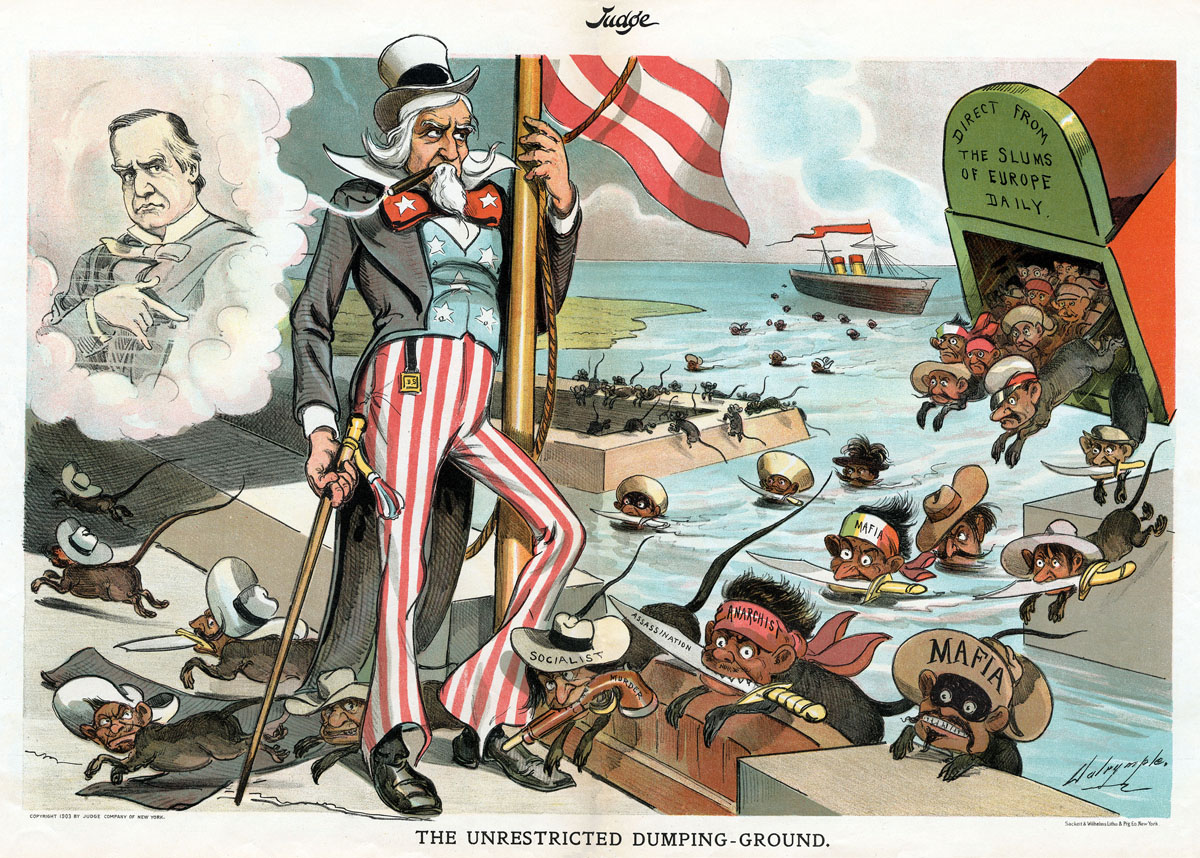
Louis Dalrymple: “The Unrestricted Dumping-Ground” (1903)
The U.S. in 1903 was transitioning from the Gilded Age to the Progressive Era, which included expansion of individual rights. That era also saw more immigrants entering the country — with some facing backlash.
Louis Dalrymple captured that in this cartoon for Judge Magazine. It features the spirit of President William McKinley, who was assassinated two years earlier by a U.S.-born anarchist whose parents were eastern European immigrants. The cartoon is explicit in how it portrays immigrants as rats being “dumped” into the U.S. “direct from the slums of Europe.”
Roberta MacDonald: “Delivering the Baby” (1941)
The New Yorker is known for its punchy, witty and sometimes obscure cartoons that poke at culture in the time they’re published. As men were drafted into military service, the World War II era saw many women joining the workforce in both civilian and government roles that were previously dominated by men. Roberta MacDonald started contributing to these New Yorker cartoons in 1940, with this one published on Dec. 13, 1941, six days after the Japanese attack on Pearl Harbor launched the U.S. into the war.
MacDonald’s work often highlighted the role of women in public working life while balancing their families at home.

Herbert Block (aka Herblock): “You Read Books, Eh?” (1949)
Herbert Block, known by his penname Herblock, is among the most famous political cartoonists in U.S. history, having won three individual Pulitzer Prizes for his work. His career reached a notable peak in the late 1940s and 1950s as the Red Scare took hold of U.S. politics. He is credited with coining the term “McCarthyism” to criticize the anti-communist work of U.S. Sen. Joseph McCarthy. This cartoon, from 1949, is one of his many famous political cartoons that depicted government agents as overly intrusive.
Block would go on to depict President Richard Nixon as a crook during the Watergate scandal and share in a staff Pulitzer Prize for The Washington’s Post’s coverage.
Thomas Stockett: “A Ride to Political Disaster in ’62” (1961)
As cartoonist for the Baltimore-based, Black-focused newspaper chain Afro-American, Thomas Stockett’s work brought a perspective not often seen in many newspapers that featured work by only white cartoonists.
His cartoons during the Civil Rights era, including this one, showed the growing allegiance of Southern Democrats, known as Dixiecrats, with Republicans in opposing civil rights legislation.
Charles Brooks: “I Plan to Lead Another Non-Violent March Tomorrow” (1968)
Though Martin Luther King Jr. is celebrated today with a national holiday, at the time of his work in the 1960s, most people in the U.S. opposed his movement. Some opposition came from newspaper editorials and cartoons, such as this one from Charles Brooks in The Birmingham News. Brooks also drew notable cartoons that criticized the Ku Klux Klan.
The media at times depicted King as leading protests and marches that were destructive or led to riots, even though his longtime message to others marching with him was one of nonviolence.
View this post on Instagram
Garry Trudeau: “Doonesbury” and the Pulitzer Prize (1975)
Editorial cartoons are typically found in the opinion section of newspapers, not the “funnies” section with comic strips like “Peanuts” and “Calvin & Hobbes.” That’s why it was groundbreaking when, in 1975, Garry Trudeau’s “Doonesbury” became the first daily comic strip to win the Pulitzer Prize for editorial cartooning.
His strip, which began in 1970, was influenced by the 1960s counterculture movement and his own experience as a college student during that time. For more than five decades, the comic has tracked the life of Michael Doonesbury, whose name was inspired by Trudeau’s actual college roommate at Yale University. The strip frequently delved into politics and culture by examining the actions of fictionalized U.S. presidents based on the real ones.
Over the decades, it earned praise from readers and the ire of some politicians. U.S. Sen. John McCain denounced the comic on the Senate floor for criticizing military veteran Bob Dole during his presidential campaign. In the same era, Trudeau poked at the sex scandal and impeachment of President Bill Clinton and depicted him as a waffle over a tendency to flip-flop on issues for political expediency. Trudeau’s comic has influenced media off the comics pages, spurring a Broadway musical in 1983 and the spinoff streaming series “Alpha House” on Amazon Prime.
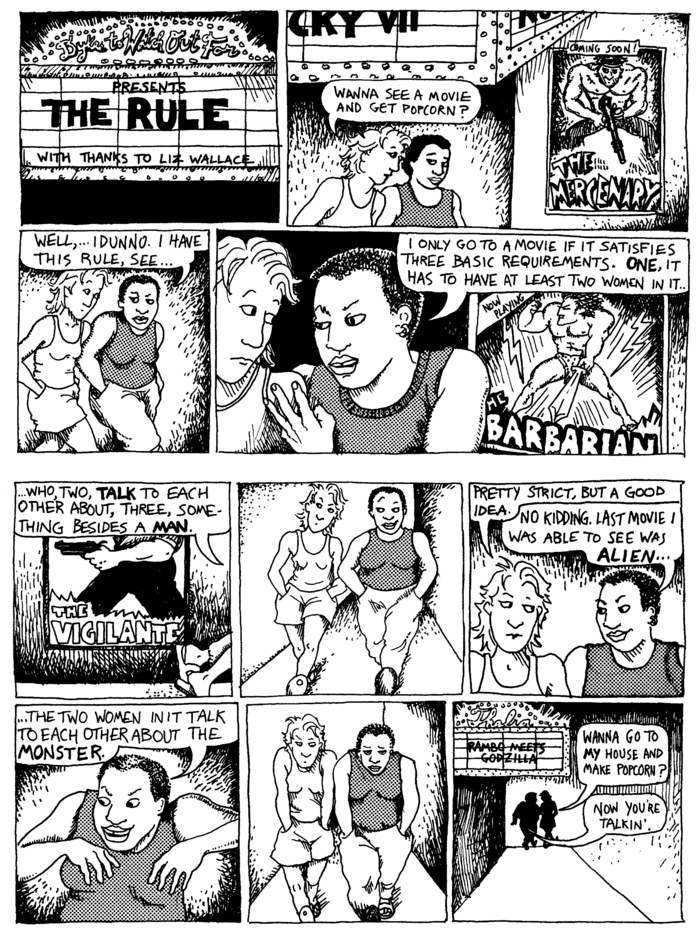
Alison Bechdel: The Bechdel Test (1985)
Alison Bechdel has been publishing her thoughts on society, culture, gender and sexuality for more than 40 years, with her “Dykes to Watch Out For” comic popular in alternative newspapers and online. This 1985 comic didn’t make international waves and news at the time. But in the decades since, it’s come to outline “the Bechdel Test,” a way of measuring the representation of women in Hollywood film and TV.
The original comic and the larger test have received widespread attention in the past 15 years as Hollywood and the larger entertainment industry examine how women and other historically underrepresented groups are portrayed in media. Bechdel herself told The Guardian in 2023 that the comic that led to the test “was a joke.” “I didn’t ever intend for it to be the real gauge it has become and it’s hard to keep talking about it over and over, but it’s kind of cool.”
Lalo Alcaraz: Border Wall (2016)
The Herb Block Foundation annually gives out the Herblock Prize for excellence in editorial cartooning. In 2022, the prize went to Lalo Alcaraz. For more than 30 years, Alcaraz has drawn political cartoons that highlight the experience of immigrants and comment on civil rights issues on national and local scales.
Since 2016, much of his work, including this cartoon, has criticized rhetoric against immigrants and the policies of the first and second administrations of President Donald Trump. Alcaraz has also criticized those who identify with the Latinos for Trump movement, especially since 2024, as deportation policy has become a flashpoint in national politics.
Michael Ramirez: “Free Speech on Campus” (2017)
Having worked for the Los Angeles Times, Las Vegas Review-Journal and Investor’s Business Daily, Michael Ramirez’s cartoons have been published widely and earned him two Pulitzer Prizes. His conservative-leaning cartoons have poked fun at the policies of President Barack Obama, and he has two books of cartoons titled “Everyone Has the Right to My Opinion” and “Give Me Liberty or Give Me Obamacare,” the latter a nod to the famous Patrick Henry quote.
More recently, Ramirez has published cartoons that highlight his views on “cancel culture” and a perceived lack of tolerance for free speech on college campuses — such as this one.
Ann Telnaes: Tech Leaders and Donald Trump (2025)
As a Washington Post cartoonist since 2008, Telnaes used her platform to criticize and critique politics — and her own boss. Amazon founder Jeff Bezos owns the Post, and Telnaes submitted this cartoon, which criticized Bezos and other billionaires and corporate leaders for what she presented as bowing down to President Trump after his re-election in 2024. Post editors declined to run the cartoon, and Telnaes quit in protest. The ensuing fallout prompted many people to criticize the Post and cancel subscriptions.
Her body of work earned Telnaes a 2025 Pulitzer Prize, which the prize committee said was “For delivering piercing commentary on powerful people and institutions with deftness, creativity – and a fearlessness that led to her departure from the news organization after 17 years.”
Political cartoons and the First Amendment
Thanks to the First Amendment, political cartoons have been used for centuries to express dissent, criticize, poke fun and tell stories. And while the right to create, publish and share these cartoons isn’t without its limits, there’s no doubt that political cartoons have played an important role in shaping the public conversation and spurring debate.
Scott A. Leadingham is a content writer at Freedom Forum. He can be reached at [email protected].

Violence in Media: How (and Why) Graphic Images Make the News

Can Public Officials Block You Online?
Related Content
You have the right to express yourself IRL.
