
Five 1A Questions With New Freedom Forum First Amendment Specialist Alex Morey
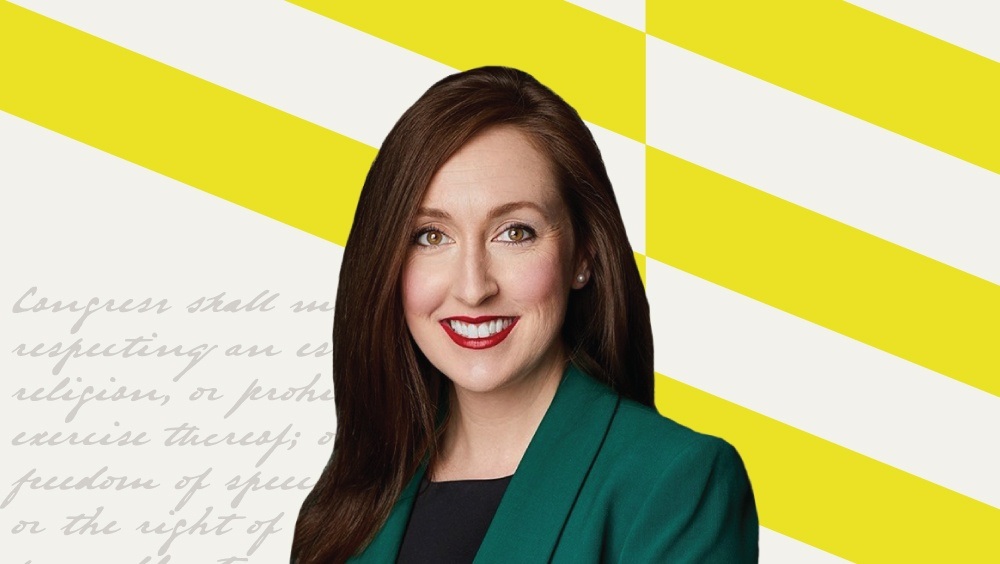
Alex Morey is Freedom Forum’s new First Amendment specialist. Her work focuses on deepening public understanding of how this core constitutional protection shows up in our courtrooms and communities. Before joining Freedom Forum, Morey spent nearly a decade at the Foundation for Individual Rights and Expression, where she led FIRE’s flagship program promoting and defending expressive rights for college students and faculty. She is a member of the First Amendment Lawyers Association and is licensed to practice law in the District of Columbia, New York and her current home state of Wisconsin. Learn more about Morey’s background and expertise here.
How did you become interested in First Amendment issues? What led you to where you are today, career-wise?
I was naturally interested in journalism as a kid. Barbara Walters started it.
By the fourth grade, “20/20” on Friday nights was appointment viewing for me. Barbara was a woman who could essentially mine people for truth. Implicit in that fact was that one could learn to do this. And what a valuable public service! To root out these solid gold truth nuggets. To show the world as it is. To force important people to tell you their secrets.
College and the years directly after would put me on a more First Amendment-focused path. I majored in journalism and worked on the campus paper. My freshman year, I was as useless as my story ideas — groundbreaking stuff like “College students not getting a lot of sleep!” But the very patient editors in chief mentored me, and, slowly but surely, I learned!
Post-graduation, I felt like I was still missing some critical education, so I joined the Peace Corps and was assigned to teach English in Madagascar. I got a side gig working on the weekends with the U.S. Embassy, which needed someone to teach local journalists how to put their stories online. It was the early days of blogging, and I was teaching the very basics.
But as I was giving my little blogging tutorials, casually talking about all the hard-hitting investigative stories the local journalists might cover, the reporters were shooting each other looks.
Afterwards, one of them pulled me aside and explained that everything I was suggesting was totally off limits. They might get arrested — or have their families targeted — for asking those kinds of questions. There were some things they just could not cover. They’d pretty much accepted it, and I needed to, too.
I said OK, that I understood.
Both were lies.
Instead, that interaction became my First Amendment origin story, and from there on out, our girl Barbara Walters took a back seat to basic rights on my career path.
Your career has had a particular focus on the First Amendment on college campuses. What do you think are the biggest issues in this area currently?
College campuses are way too quiet.
Students and faculty — heck, administrators now, too — are scared to talk about anything that might be considered divisive.
For a decade or so, I’ve given basic First Amendment lectures to student groups on campuses around the country. And every year, the Q&As at the end were getting shorter and quieter. Inevitably, students would wait for me after the lecture, and then they'd quietly tell me what they really thought about some issue or another. And, they’d add, there was “no way” they were about to say the thing they just told me in a big lecture hall, where someone might be filming them and putting it on Snapchat, or where their comment might get misconstrued and cost them their spot in student government or in their friend group. It was the same in their classes.
Hard conversations are a part of life. An education has to include teaching students how to have them. College campuses are the place to be teaching this stuff. A First Amendment framework — that allows for the widest possible range of speech — is perfect for college campuses. It’s all about ideological diversity. It’s all about ideological inclusion. Everyone should be able to ask questions, test theories and explore the limits of their own beliefs.
Silence — whether you’re forcing it on someone else or choosing it for yourself — can be so tempting when we’re worried about being judged. But silence only mutes our problems, and it mutes us. Enforced silence won’t solve root issues, and self-censorship stops us from showing up authentically to work for real change.
College students are, by and large, young adults. It’s up to the rest of us — the proverbial adults in the room — not to give into the temptation to suppress difficult conversations or sanitize campuses to manage our own anxieties around controversy. Instead, educators are in the perfect position to empower young adults to choose constructive engagement over repression and silence.
What keeps you up at night regarding the First Amendment and the freedoms it guarantees?
The First Amendment needs a better publicist.
It’s getting a bad rap, and it’s undeserved. The First Amendment seems to bring up a lot of fear and anxiety for people, and that brings up a lot of fear and anxiety for me. I’ve seen so much of the good it can do and so many bad things that happen when First Amendment norms aren’t respected.
The First Amendment is one of the best tools we have for protecting our expressive rights, and that should reduce fear, but that’s not how most people are experiencing free expression right now. The First Amendment — talking about it, defending it, even using it — seems to provoke all kinds of anxieties for people because of the polarization in our country.
So many of the divides in America right now strike at the heart of our core identities, and there’s good data showing that this makes talking across lines of difference a very visceral, unpleasant, even scary experience.
It doesn’t have to be this way. But we have to learn to listen and talk to each other in ways that feel less scary.
The First Amendment is a great guardrail against the government messing with our expressive rights, but it can’t make people care about having those rights. People can’t be forced to use them.
My concern is that people will believe the First Amendment’s unfair press and be willing to cut it down or give it up — ultimately to their own detriment.
If you could overturn any First Amendment case decided by the U.S. Supreme Court, which would it be and why?
TikTok Inc. v. Garland, the TikTok ban case. That decision had First Amendment folks picking their jaws up off the floor.
The question before the U.S. Supreme Court was whether the government could force TikTok to sever ties with its Chinese parent company, ByteDance, over concerns the Chinese government was accessing Americans’ data.
National security has always been one of those areas where the government gets more leeway in regulating speech. But in modern First Amendment jurisprudence, courts have always required at least some concrete evidence that the government has a good reason to do so. The government has to demonstrate there is a national security threat.
Here, the court basically let the government effectively shut down one of the biggest free speech platforms in the U.S. without having to show any evidence that it had a good reason to do it.
The TikTok decision creates a major loophole, where government actors can justify suppressing all manner of speech, as long as they use the magic words: national security.
You’re a fan of stand-up comedy, which, of course, is brought to us by the First Amendment. Who's your favorite comedian and why?
Oh man, I was getting stressed out with those last few questions.
Comic relief right on time.
Boy, it’s impossible to pick an all-time favorite. But I've got three kids and am turning 40 next month, so the meteoric rise of the older mom comic has my full attention right now. Leanne Morgan and Zarna Garg — with their big families and big accents — are having a big moment, and it’s about time!
Moms today, whether we’re working in or outside the home, are under so much pressure to be amazing at everything, look perfect and smile about it — all with a fraction of the village or resources it takes to do any of these things. Biologically, evolutionarily, we’re not supposed to be raising kids siloed off from the rest of the world. We’re supposed to have the kinds of big, interconnected communities that modern life just isn’t giving to a big subset of American women.
Modern life has, however, given us bathrooms to lock ourselves away in when the kids are shredding our last nerve. And it has given us the Leanne Morgan YouTube clip where she talks about watching “Quarterback” on Netflix and worrying to death about Patrick Mahomes and Taylor Swift. And that little combo has been giving me life on days when I might otherwise tear my hair out.
Fellow frazzled moms, do yourself a favor: Go hide and give it a watch.

U.S. Journalist Evan Gershkovich Marks One Year of Imprisonment in Russia

Related Content